AI Call Coaching in Salesforce for Mobile Teams: Why Capture Comes First
AI call coaching is moving quickly from manager review into automated scoring, live prompts, summaries, and Salesforce connected performance data.
That is useful progress. Sales leaders should be able to coach more than a tiny sample of calls. New reps should learn faster. Managers should see real objections, talk tracks, next steps, and customer risk without spending their whole week listening to recordings.
But there is a quiet problem for mobile teams.
AI call coaching can only coach the conversations it can see.
If your Salesforce data includes calls made through a desk phone, browser dialler, contact centre queue, or mobile app, but misses ordinary mobile calls, the coaching view is incomplete. The manager may think they are coaching from the full reality of the team. In practice, they may only be coaching the part of the workflow that passed through the approved tool.
For field sales, recruitment, service, real estate, financial advice, and account management teams, that can leave some of the most important conversations out of the coaching loop.
The short answer
AI call coaching in Salesforce works best when every meaningful customer call is captured, matched to the right Salesforce record, and enriched with useful context such as recording, transcript, summary, outcome, next action, and rep ownership.
For mobile teams, the first buying question is not which coaching model has the smartest scorecard. It is whether the system captures the real mobile conversations your team already has.
If reps call and answer customers through the normal mobile dialler, coaching quality depends on whether those cellular calls reach Salesforce without extra work from the rep.
What AI call coaching actually needs
AI call coaching usually depends on a few layers of data.
First, the call has to be captured. Without the audio or call record, there is nothing to review.
Second, the conversation needs a transcript. This gives the AI and the manager a searchable source record, not just a timestamp and duration.
Third, the system needs context. Who was involved, which Salesforce record owns the activity, what stage the opportunity or case was in, what the customer asked, what the rep promised, and what happened next.
Fourth, the coaching workflow needs a standard. That might be a qualification framework, discovery checklist, objection handling guide, compliance review rule, customer service standard, or manager defined scorecard.
Only then can AI help with scoring, feedback, talk track review, coaching themes, and rep development.
The quality of the coaching depends on the quality of the capture underneath it.
Why mobile teams are harder to coach from Salesforce
Desk based calling workflows are easier to control. A rep may start the call from Salesforce, use a browser dialler, follow a sequence, and complete the call inside the same platform.
Mobile teams behave differently.
A field rep calls a customer after leaving a site visit. A recruiter speaks with a candidate while walking between meetings. A service manager answers a direct mobile call from a customer. An adviser returns a call from the native phone app because that is the fastest way to respond.
Those conversations can contain the material a manager most wants to coach:
- How the rep handled a pricing concern
- Whether the rep asked a useful discovery question
- Whether the customer gave a clear buying signal
- Whether the next step was agreed
- Whether a sensitive or regulated topic was handled properly
- Whether the rep followed the team process when the conversation became difficult
If those calls do not reach Salesforce, they cannot be scored, reviewed, summarized, or used for coaching.
That means the manager is coaching from a partial sample. The cleanest data may come from the most controlled calls, while the messy and valuable mobile conversations stay invisible.
The risk of coaching from partial call data
Partial data can make coaching look more complete than it is.
A dashboard may show call scores, sentiment, talk time, next steps, and objection trends. It may show that a manager has reviewed a healthy number of calls. It may show coaching recommendations by rep.
But if ordinary mobile calls are missing, those insights can be skewed.
A rep who follows the app workflow may look easier to coach because more of their calls are visible. A rep who spends more time in the field may look quieter than they really are. A customer objection may appear rare because it often comes up during direct mobile callbacks. A manager may coach on formal discovery calls while missing the follow up call where the customer actually made the decision.
The issue is not that AI coaching is bad. The issue is that AI coaching becomes less trustworthy when the source data excludes a meaningful part of the customer conversation trail.
For Salesforce teams, this matters because coaching does not sit on its own. It affects pipeline reviews, enablement priorities, rep performance plans, customer handovers, compliance review, and the confidence leaders place in Salesforce activity data.
Call scoring is not the same as call coverage
Call scoring asks how well a conversation met a standard.
Call coverage asks whether the conversation was captured in the first place.
Both matter, but they solve different problems.
A scorecard can tell you whether a rep asked about budget, timeline, decision process, risk, or next action. It can help managers compare calls and identify coaching themes.
It cannot score a call that never reached the system.
That is why mobile teams should separate two evaluation questions when choosing AI coaching tools.
The first question is about coaching quality. Can the tool score the right criteria, explain its reasoning, show evidence from the transcript, and help managers coach consistently?
The second question is about capture quality. Does Salesforce receive the ordinary mobile calls that happen outside the desk based workflow?
If the second answer is weak, the first answer has a smaller ceiling.
What managers should see after a mobile call
A useful coaching record in Salesforce should make the call easy to understand and easy to act on.
At minimum, managers should be able to see the call owner, direction, time, duration, and matched Salesforce record.
Where recording and transcription are appropriate under company policy and local rules, they should also be able to review the recording, transcript, AI summary, outcome, next action, and any coaching signals attached to the call.
The strongest coaching records answer practical questions:
- What happened on the call?
- Which customer, candidate, case, account, opportunity, or custom record was involved?
- What did the rep do well?
- What should the rep improve next time?
- What evidence supports the coaching note?
- Was the promised next step captured?
- Does this call change the manager view of the relationship or deal?
This is where Salesforce context matters. A coaching note is more useful when it sits next to the account history, opportunity stage, prior activity, and follow up task.
The call should not live as a detached recording in one system and a vague note in another.
Why live coaching does not remove the need for complete capture
Live coaching can be valuable. During a call, AI may surface prompts, reminders, battle cards, objection guidance, or suggested questions.
That is helpful when the call happens inside a workflow that supports live guidance.
But many mobile conversations happen outside that environment. A rep may answer a normal mobile call while travelling. The customer may call the direct number they already know. The conversation may happen in a place where opening a separate app is unnatural or unreliable.
In those cases, post call capture still matters.
Even if the rep did not receive live prompts, Salesforce should still know what happened. The transcript can support manager review. The summary can support handover. The outcome can support reporting. The next action can support follow up. The coaching signal can support development.
For mobile teams, the realistic goal is not to force every conversation into the same controlled interface. It is to make sure the business captures the conversations that actually happen.
What to ask before relying on AI coaching in Salesforce
Before rolling out AI call coaching for a mobile team, ask a few practical questions.
- Are normal cellular calls captured, or only calls made through a dialler, app, or browser?
- Are inbound mobile calls captured as reliably as outbound calls?
- Does capture work when the rep has poor mobile data coverage?
- Are calls matched to the right Salesforce records?
- What happens when the caller is unknown or matches more than one record?
- Are recordings, transcripts, summaries, outcomes, and next actions visible in Salesforce?
- Can managers review evidence from the actual conversation?
- Can coaching signals be connected to Salesforce activity, opportunity, case, or account context?
- Does the workflow depend on reps changing how they call customers?
- Can leaders see which calls were captured and where coverage gaps remain?
The best coaching stack cannot fix a weak capture layer. It can only analyze the data it receives.
Where RocketCell fits
RocketCell is built for Salesforce teams whose important conversations happen on mobile phones.
Instead of asking reps to route every business conversation through a separate app, RocketCell captures ordinary mobile calls through a real mobile network setup using eSIM or SIM.
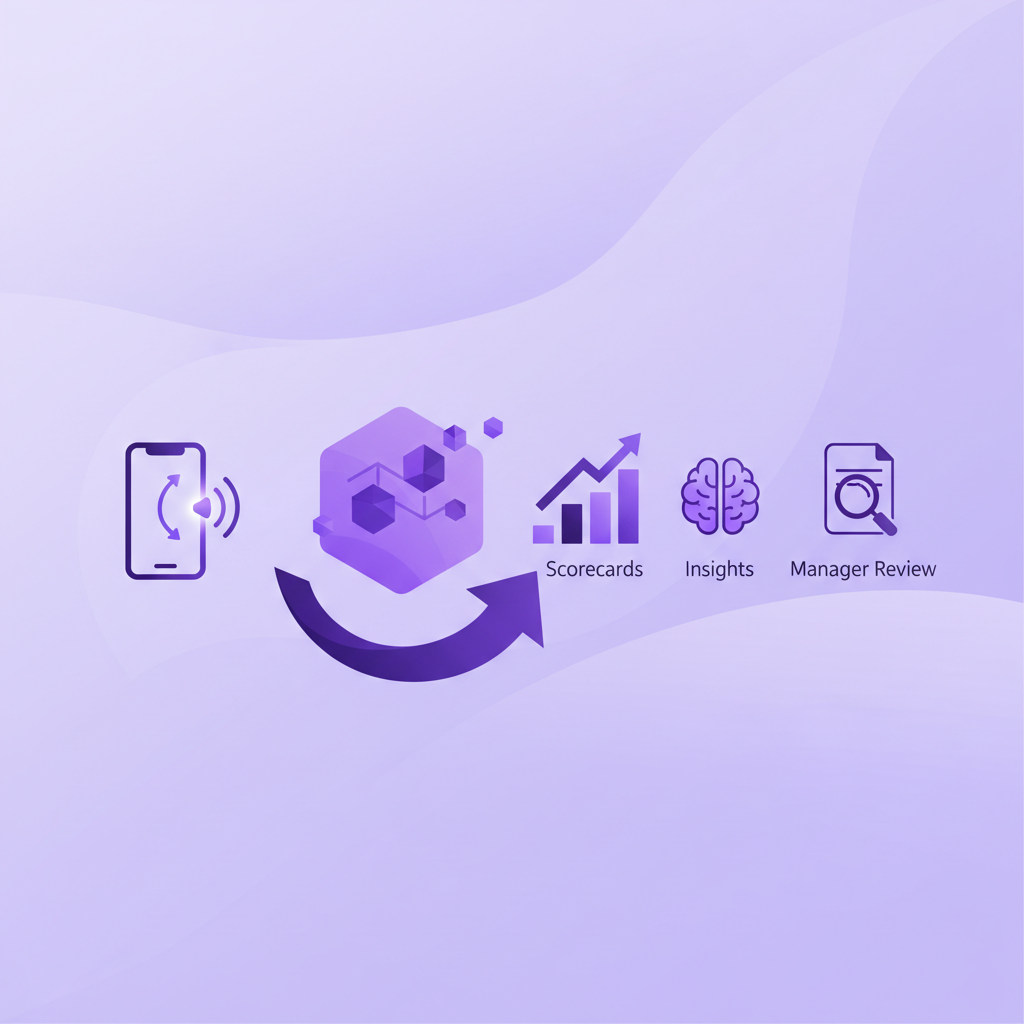
When a mobile call ends, RocketCell can log the call to Salesforce, match it to the right record, and add useful conversation context such as recording where appropriate, transcript, AI summary, outcome, and next action.
That gives managers a stronger foundation for coaching. They can review the real field conversations that shape deals, service outcomes, recruitment progress, customer risk, and handovers. They are not limited to the calls that happened inside a desk based or app led workflow.
RocketCell is not trying to replace every coaching, revenue intelligence, enablement, or contact centre platform. Those tools can be valuable. The specific RocketCell role is upstream. It helps make ordinary mobile conversations visible in Salesforce so coaching and AI workflows have better source data to work with.
The practical takeaway
AI call coaching is only as complete as the call data underneath it.
For Salesforce mobile teams, the most important coaching moments often happen away from the desk. They happen in direct callbacks, field conversations, urgent service calls, candidate calls, client updates, and quick mobile follow ups.
If those calls are missing, managers coach from a polished but partial picture.
Before choosing a coaching workflow, check the capture workflow. Ask whether Salesforce sees the calls your team actually makes and answers. Ask whether those calls are matched to the right records. Ask whether the recording, transcript, summary, outcome, and next action are available for review.
Once the mobile conversations are captured, AI coaching becomes much more useful.
That is how Salesforce moves from selective call review to a clearer view of how the team really speaks with customers.