
Unknown Mobile Callers in Salesforce: What Should Happen Before AI Acts?
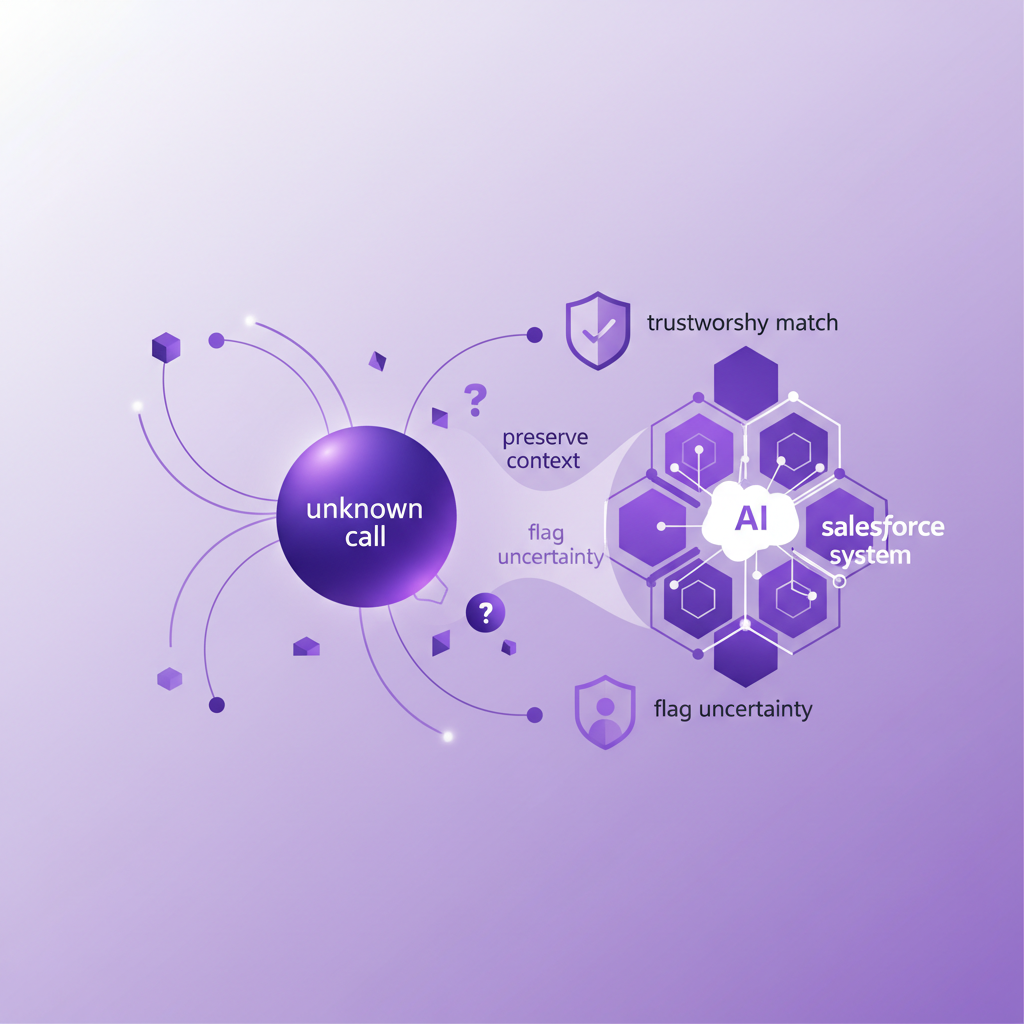
An unknown mobile caller should not automatically become a messy Salesforce record. The right workflow should capture the call, preserve the number, connect the conversation to the right rep, check for existing Salesforce context, create a reviewable record when needed, and only then let automation or AI act on it.
That distinction matters more than it used to.
Salesforce teams are moving quickly toward AI summaries, automated routing, lead creation, follow up tasks, and voice agents. Those workflows can be useful, but they depend on a simple assumption: Salesforce knows who called and what that call means.
With mobile teams, that assumption often breaks.
A prospect calls a field sales rep back from a personal mobile. A customer rings a service technician from a number that is not saved on the Contact. A known stakeholder uses a direct line from another office. A hiring manager calls from a switchboard number. The conversation matters, but the number does not neatly match a clean Lead or Contact.
If the system ignores the call, Salesforce loses context. If it creates a new Lead every time, Salesforce fills with duplicates and half known records. If it attaches the call to the wrong person, reporting, coaching, compliance review, and AI workflows inherit the mistake.
The goal is not simply to identify every unknown caller instantly. The goal is to make unknown calls visible, reviewable, and safe to act on.
What is an unknown mobile caller in Salesforce?
An unknown mobile caller is a business call where the phone number does not clearly match an existing Salesforce record at the moment the call is captured.
That can happen for several reasons:
- The caller is genuinely new to the business
- The caller exists in Salesforce, but the number is missing
- The number is stored in the wrong field or format
- The same number appears on more than one record
- The caller uses a switchboard, shared office line, or temporary number
- The call relates to an Opportunity, Case, Account, or Candidate record rather than only a Lead or Contact
- The rep knows the caller, but Salesforce does not yet have enough data to match them reliably
For desk based telephony, unknown caller workflows often focus on screen pops and automatic Lead creation. That is useful in some inbound sales environments. For mobile teams, the workflow is usually messier because calls happen through normal mobile behaviour, often outside a controlled dialler, contact centre queue, or browser based calling flow.
That is why a mobile call capture strategy needs a more careful answer than "create a Lead."
Why automatic Lead creation can be useful
Automatic Lead creation solves a real problem. If a new prospect calls and no Salesforce record exists, creating a Lead can prevent the conversation from disappearing. It gives the team a place to store the call activity, assign ownership, trigger a response process, and report on inbound demand.
For high velocity sales teams, that can be valuable. A blank number in a phone log is not much use. A Salesforce Lead with the caller number, owner, timestamp, direction, recording, transcript, and summary is much easier to work.
The benefit is speed and visibility.
Without automation, reps often have to remember the call, create a record later, type notes from memory, and decide where the activity belongs. Many short calls never make it into Salesforce at all. The result is invisible demand, incomplete activity reporting, and managers asking why the pipeline changed without a clear conversation history.
Automatic creation can close that gap when the caller is genuinely new.
The risk is that not every unknown number is a new person.
Why automatic Lead creation can also damage Salesforce data
An unknown caller workflow becomes dangerous when it treats every unmatched number as a new Lead without checking the wider Salesforce context.
That can create several data problems.
First, duplicates multiply. A customer who already exists as a Contact may call from a mobile number that was never saved. If the system creates a new Lead, the activity is now split across two records. The next rep sees partial history. The manager sees misleading activity. AI tools may treat the same person as two different people.
Second, account context gets lost. A buyer might call from a number that belongs to a branch office, project site, or shared reception desk. Creating a standalone Lead may separate the call from the Account, Opportunity, or Case where the work is actually happening.
Third, ownership becomes confused. If an inbound mobile callback reaches the rep who has been working the deal, it may be more useful to log a reviewable Task against that rep and the likely commercial context than to create a new unqualified Lead owned by a queue.
Fourth, AI can act too confidently. If an AI summary, next action, or routing workflow runs against the wrong record, it can update the wrong pipeline, notify the wrong owner, or create follow up work that looks precise but is based on a bad match.
This is the practical data quality problem underneath unknown callers. The issue is not only whether the call is captured. It is whether the captured call becomes trustworthy Salesforce context.
What should happen when an unknown mobile caller rings?
A good unknown caller workflow should separate capture from decision making.
The call should be captured first. The number, direction, timestamp, duration, rep, recording, transcript, and any AI summary should be preserved even if Salesforce cannot immediately identify the caller.
Then the system should check for useful signals.
Does the number match a Lead, Contact, Account, Case, or custom object? Does it match more than one record? Is there an open Opportunity owned by the rep who received the call? Has this number appeared in recent call history? Did the caller mention a company, project, case reference, property, order, or candidate name in the conversation?
If there is one confident match, the call can be attached to the right Salesforce record.
If there are several possible matches, the call should be flagged for review rather than silently attached to the wrong place.
If there is no match, the workflow should create the right kind of holding record for the business. In some teams, that will be a new Lead. In others, it may be a Task awaiting review, a Case intake record, a queue item, or a custom object that lets an operations team enrich and assign the caller before downstream automation runs.
That review step matters. Unknown does not always mean new. It often means Salesforce needs a better identity signal before the next workflow should trust the call.
What Salesforce should store for an unknown call
Even when the caller cannot be identified immediately, Salesforce should still receive enough information to make the call useful.
At minimum, the record or activity should include:
- The caller number in a consistent format
- Call direction
- Start time and end time
- Duration
- The rep or user who made or received the call
- Whether the caller was unmatched, confidently matched, or ambiguous
- Recording availability where recording is enabled
- Transcript availability where transcription is enabled
- AI summary where summary is enabled
- Suggested next action if the system can infer one safely
- Review status
- Final linked Lead, Contact, Account, Opportunity, Case, or Task once resolved
This makes the unknown caller problem measurable. RevOps can see how many mobile calls are unmatched, how many are later resolved, how often duplicates are created, and which teams need better phone data inside Salesforce.
It also gives AI a safer foundation. A summary can describe what was said. A workflow can suggest a next step. But the system should be clear about whether the caller identity is known, inferred, or still awaiting review.
How unknown callers affect AI agents in Salesforce
AI agents are only as reliable as the context they receive.
If an agent sees an unknown call as a new Lead, it may start a new qualification path even though the caller is an existing customer. If it sees a duplicate Contact, it may miss the real Opportunity history. If it sees the wrong Account, it may produce a confident summary that sends a team in the wrong direction.
For mobile teams, the risk is higher because important conversations often happen outside the place where automation is designed. A field rep may take a direct callback while travelling. A service engineer may receive a customer call between site visits. A consultant may speak to a client from the native mobile dialler because that is how the relationship already works.
The AI layer cannot fix what the capture layer never saw. It also cannot always know that a phone number belongs to a known relationship unless the call is captured, matched, and reviewed in Salesforce.
This is why unknown caller handling should be part of AI readiness. Before giving agents permission to update records, assign work, or trigger customer communication, teams should decide how unknown and ambiguous mobile calls are handled.
Buyer questions for Salesforce teams
If your team relies on mobile calls, ask these questions before trusting an unknown caller workflow:
- Does the system capture normal mobile calls, or only calls made through an app, softphone, or browser?
- What happens when a number does not match any Lead or Contact?
- Does the workflow always create a Lead, or can it hold the call for review?
- Can the call be matched to Accounts, Opportunities, Cases, Tasks, or custom objects where relevant?
- What happens when the same phone number appears on more than one Salesforce record?
- Does the system preserve the recording, transcript, summary, and metadata while identity is unresolved?
- Can RevOps report on unmatched, ambiguous, and resolved calls?
- Are AI summaries and follow up actions clearly marked when caller identity is uncertain?
- Can users correct or confirm the match without losing the original call history?
- Does the process reduce duplicates, or does it create new ones faster?
The best answer is rarely one universal rule. A new business inbound team may want fast Lead creation. A regulated service team may need review before routing. A field sales team may want likely Opportunity context. A recruitment team may need candidate, client, and job context before the call becomes actionable.
The workflow should match the way the team actually uses Salesforce.
Where RocketCell fits
RocketCell.ai is built for the mobile conversations that often sit outside ordinary Salesforce visibility.
Instead of depending on reps to start every call from a separate app or recreate the conversation after the fact, RocketCell captures normal mobile calls through the business mobile layer and brings the conversation into Salesforce with the useful context around it.
That matters for unknown callers because the first job is not magic identity resolution. The first job is reliable capture.
Once the call is captured, Salesforce can receive the mobile call activity, recording, transcript, summary, and matching context needed for review, reporting, and downstream workflows. Known calls can become richer Salesforce activity. Ambiguous calls can be treated carefully. Unknown calls can be surfaced instead of disappearing into a personal mobile history.
For teams using AI summaries, Agentforce style workflows, or automated follow up, this is the difference between acting on a clean customer history and acting on a partial one.
The practical rule
Unknown mobile callers should not be ignored, and they should not always be rushed into Salesforce as new Leads.
The better rule is this: capture every relevant mobile call, preserve the evidence, check the Salesforce context, show uncertainty clearly, and let automation act only when the match is good enough.
That gives reps less admin, managers better visibility, RevOps cleaner data, and AI workflows a stronger foundation.
For Salesforce teams where customer calls happen on mobiles every day, unknown caller handling is not a small edge case. It is one of the places where CRM trust is either protected or quietly eroded.