Call Purpose vs Call Outcome in Salesforce: What Mobile Teams Should Record
A mobile call finishes and Salesforce receives a neat activity record. The contact is matched, the duration is present, and an AI summary explains the conversation.
But two basic questions can still get confused.
Why did the call happen?
What happened because of it?
The first question is call purpose. The second is call outcome. They sound similar, but they describe different parts of the conversation. When Salesforce teams combine them in one field, reporting becomes muddy and automation becomes harder to trust.
For mobile teams, the distinction matters even more. A planned sales call may turn into a service escalation. A customer may call about a renewal and finish by requesting a pricing review. A recruiter may ring to discuss one role and discover that the candidate is no longer available.
The reason a call started is not always the result it produced.
What is the difference between call purpose and call outcome?
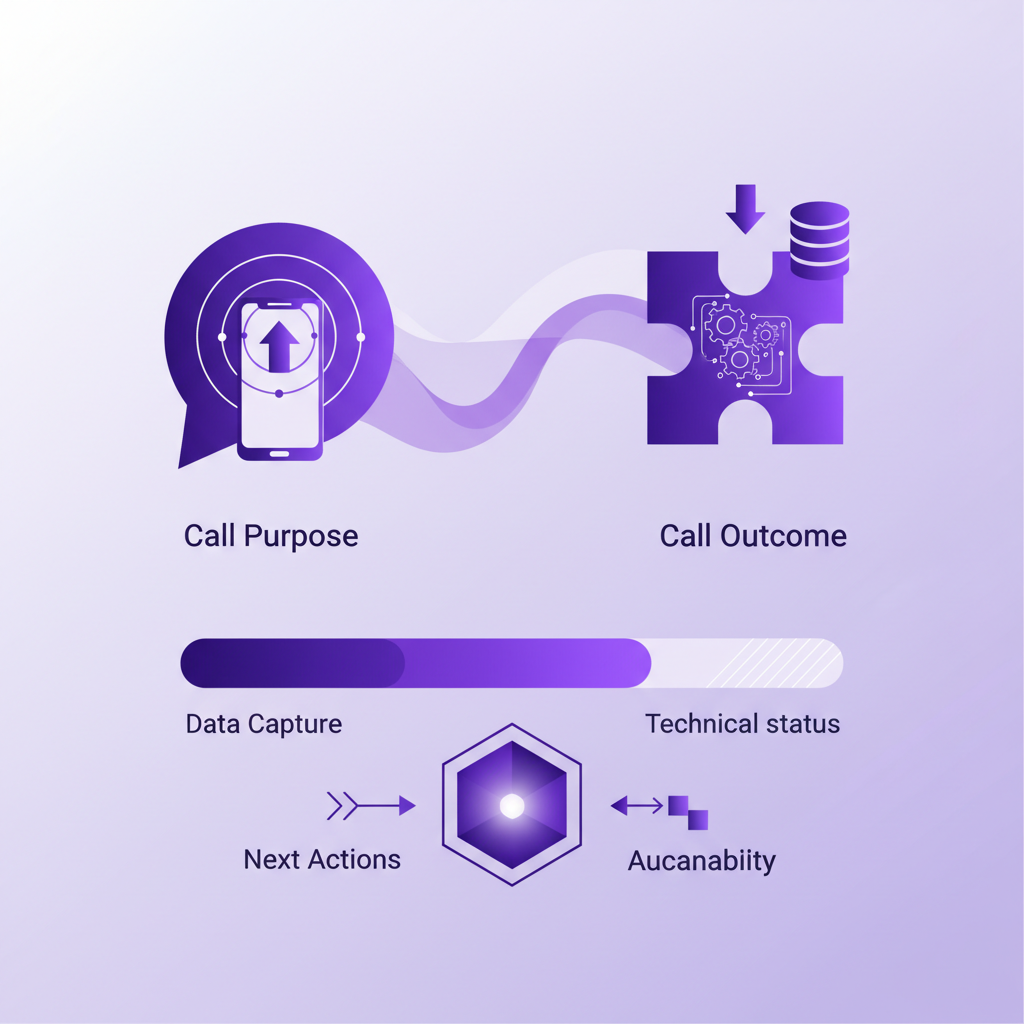
Call purpose records why the conversation happened. It describes the need, topic, or intention at the start of the call.
Call outcome records what the conversation achieved or established. It describes the result at the end of the call.
Next action is a third concept. It records the work that should happen after the call, including the owner and due date where appropriate.
Consider a simple example.
- Call purpose: Discuss renewal.
- Call outcome: Customer requested revised pricing before making a decision.
- Next action: Account manager to send revised options by Friday.
Those three fields tell a useful story. Combining them into one label such as renewal follow up loses precision. It becomes difficult to tell whether the call was planned as a renewal discussion, whether the renewal progressed, or what anyone agreed to do next.
Why should Salesforce keep purpose and outcome separate?
Purpose and outcome answer different management questions.
Purpose helps teams understand demand. Why are customers and prospects speaking with us? Which topics create call volume? What work is reaching field teams directly? Which campaigns, service events, account stages, or customer needs are producing conversations?
Outcome helps teams understand results. Did the customer agree to a meeting? Was the issue resolved? Did the opportunity progress? Was a candidate interested? Did the call reach voicemail? Did the customer ask for more information?
When both are captured consistently, leaders can compare intent with result.
A sales manager can see how often pricing review calls lead to a commercial next step. A service leader can see how many access issue calls are resolved during the first conversation. A recruitment manager can compare the reasons for candidate calls with the outcomes they produce. RevOps can identify purposes that generate activity but rarely create progress.
If one field tries to do both jobs, those questions become much harder to answer.
A call can change purpose while it is happening
Real conversations do not always follow the label chosen before the call.
A rep may call to confirm a meeting, then hear that the buyer has introduced a new security requirement. An account manager may answer a routine product question, then discover a complaint. A service engineer may call about arrival time, then learn that the customer site is unsafe to enter.
That does not make the original purpose wrong. It means the conversation developed.
Salesforce can preserve that development in several ways.
- Record the primary purpose that best explains why the call began.
- Record a secondary purpose when another substantial need emerged.
- Use the summary to preserve important context that does not fit a controlled category.
- Record the final outcome separately.
- Create the appropriate next action or route the issue to the right workflow.
This approach keeps reporting usable without flattening a complicated conversation into one vague tag.
What makes a useful call purpose taxonomy?
A purpose list should be short enough for people to understand and specific enough to support decisions.
For a sales team, useful purposes might include discovery, qualification, proposal review, pricing discussion, stakeholder introduction, procurement update, renewal discussion, and account review.
For a service team, useful purposes might include new issue, existing Case update, appointment coordination, access question, technical diagnosis, complaint, and escalation.
For a recruitment team, useful purposes might include candidate screening, role briefing, interview preparation, offer discussion, availability update, and client vacancy review.
The exact terms should reflect the organisation. A universal list often creates categories that sound tidy but mean little to the people using them.
Three rules help.
First, each purpose should answer why the conversation occurred. Resolved, interested, and follow up required are outcomes, not purposes.
Second, categories should be mutually understandable. If employees cannot explain the difference between account review and customer catch up, the reports will not explain it either.
Third, use the smallest useful list. A long menu encourages inconsistent choices, especially when people are busy or working from a phone.
What makes a useful call outcome taxonomy?
An outcome should describe the state created or confirmed by the call.
Examples include connected, voicemail left, meeting agreed, information requested, proposal requested, decision delayed, issue resolved, Case required, escalation accepted, no longer interested, and wrong contact.
Some teams will need outcomes tied to a specific process. A financial services team may need a reviewed support outcome. A field service team may need visit booked, access confirmed, parts required, or further diagnosis needed. A recruiter may need interview agreed, candidate unavailable, offer accepted, or role declined.
Good outcome design should avoid false certainty.
Interested is not the same as meeting agreed. Positive is not the same as qualified. Resolved should not be used when a temporary workaround was provided. Decision delayed should not become lost unless the relevant sales process confirms that result.
The source conversation and summary should remain available so a user can understand what the category means in context.
Call purpose, outcome, and disposition are not always identical
Different Salesforce phone systems use different labels. One product may call the final category an outcome. Another may call it a disposition or call result. Some systems use disposition for a technical state such as connected, missed, or voicemail, while others use it for a business result such as meeting booked.
The label matters less than the definition.
Every Salesforce team should document three things clearly.
- Which field describes why the call happened?
- Which field describes what resulted from the conversation?
- Which field describes the technical call state?
Keeping the technical state separate is useful. A completed network event does not prove that a meaningful conversation occurred. A connected call does not prove that the stated business outcome is correct. A missed call has no conversation outcome, but it can still require a callback action.
Can AI detect call purpose and call outcome?
AI can help identify both purpose and outcome from a transcript, but the two tasks are different.
Purpose detection looks for the reason behind the call. That reason may be stated directly, such as I am calling about the renewal, or inferred from the opening exchange and Salesforce context.
Outcome detection looks across the full conversation. It must understand what was agreed, rejected, delayed, resolved, or left uncertain by the end.
The result should be treated according to consequence and confidence.
A low consequence category used for trend reporting may be suitable for automatic assignment when confidence is high. A result that changes an Opportunity stage, creates a formal complaint, records a regulated customer need, or commits the business to a price or date deserves stronger review.
AI should also be allowed to say uncertain. Forcing every conversation into a confident label creates cleaner looking data and weaker evidence.
Why mobile calls create a specific data gap
Purpose and outcome fields only help when the call reaches Salesforce.
Desk based phone systems often begin inside a controlled workflow. The user selects a record, starts a call, and completes after call fields in the same interface. Mobile teams do not always work that way.
A rep calls from the native dialler between meetings. A customer returns a direct call while the account manager is travelling. A surveyor takes an urgent call at a site. A recruiter answers a candidate from the normal mobile number they already use.
If those conversations remain outside Salesforce, purpose reporting covers only the calls made through approved software. Outcome reporting covers only the calls employees remembered to log. The dashboard may look precise while describing a partial sample.
For mobile teams, reliable reporting therefore starts before classification. The business needs to capture ordinary mobile calls, identify the user and direction, match the conversation to the right Salesforce context, and preserve enough evidence to support the detected purpose and outcome.
A practical Salesforce workflow for purpose and outcome
A dependable workflow can follow eight stages.
1. Capture the call
Record the call event automatically, including the business user, direction, timestamp, duration, and available conversation artifacts according to policy.
2. Match the Salesforce context
Connect the call to the right Lead, Contact, Account, Opportunity, Case, or relevant custom record. Flag ambiguous matches instead of silently choosing one.
3. Establish the technical state
Record whether the call connected, was missed, reached voicemail, failed, or ended before a meaningful conversation occurred.
4. Detect or select the purpose
Use the opening exchange, transcript, existing record context, and approved taxonomy to identify why the call happened. Preserve secondary purpose where it materially changes the workflow.
5. Determine the outcome
Review what the conversation actually established. Keep uncertain outcomes visible as suggestions until the required person confirms them.
6. Preserve the explanation
Keep a concise summary and a path to the source conversation where policy allows. A category supports reporting. The explanation helps a colleague understand the customer.
7. Create the next action
Turn an agreement into accountable work. Record what should happen, who owns it, and when it is due. Do not use an outcome field as a substitute for ownership.
8. Measure and refine
Review unknown values, frequent corrections, overlapping categories, and outcomes that fail to trigger action. Adjust the taxonomy when the data shows genuine confusion.
What should managers report on?
The most useful analysis connects the fields instead of counting them in isolation.
Managers can ask:
- Which call purposes create the most customer demand?
- Which purposes most often lead to a clear next step?
- Which outcomes appear after each purpose?
- Where do calls end without an owner or due date?
- Which teams use unknown or other most often?
- Which AI detected values are corrected most often?
- Are inbound mobile calls producing different outcomes from planned outbound calls?
- Which purposes are increasing by account, region, product, or customer stage?
- How many missed calls receive an accountable callback?
- Which outcomes change after human review?
These questions turn call data into operational insight. A chart of total calls cannot do that by itself.
Where RocketCell fits
RocketCell is built for Salesforce teams whose important conversations happen through ordinary mobile calling.
Employees can make and receive native cellular calls using a RocketCell eSIM or SIM without opening a separate calling app. The resulting mobile call can be captured and connected to Salesforce with activity data, record matching, recording where configured, transcript, AI summary, and suggested next actions.
That gives the business a stronger source for purpose and outcome classification. It also brings direct callbacks and calls made away from a desk into the same Salesforce context as more controlled conversations.
RocketCell does not decide the right taxonomy or approval policy for every organisation. Those choices belong to the team that owns the Salesforce process. RocketCell helps make the underlying mobile conversation available so those rules can work with more complete evidence.
Frequently asked questions
What is call purpose in Salesforce?
Call purpose is a structured description of why a phone conversation happened, such as discovery, proposal review, renewal discussion, service issue, or interview preparation. It should describe the need or intention, not the final result.
What is call outcome in Salesforce?
Call outcome is the result established by the conversation, such as meeting agreed, information requested, issue resolved, decision delayed, or voicemail left. The exact categories depend on the business process.
Is call outcome the same as call disposition?
Sometimes, but not always. Vendors use disposition to mean different things. It may describe the technical call state, the business result, or both. Define each field clearly before building reports or automation.
Should AI update purpose and outcome automatically?
AI can suggest or assign categories when the source call is captured and confidence is sufficient. Higher consequence outcomes should follow the organisation's review and approval rules before they change important records or trigger sensitive automation.
What should happen after a call outcome is recorded?
When work is required, Salesforce should record a next action with an owner and due date. The outcome explains what happened. The next action makes someone accountable for what happens next.
The practical takeaway
Call purpose and call outcome belong together, but they should not be collapsed into the same field.
Purpose explains why the conversation began. Outcome explains what it produced. Next action explains what the business must do now.
For mobile teams, all three depend on a more basic requirement: the real call must reach Salesforce with the right customer context. Once that foundation is reliable, teams can build clearer reports, safer automation, and a more honest view of the conversations shaping customer work.