
Call Recording Data Residency for Salesforce Mobile Teams: What Should You Verify?
Your Salesforce org may be hosted in the United Kingdom or European Union. That does not automatically mean every mobile call recording, transcript, summary, and AI output stays in the same region.
This distinction is easy to miss during a call recording project. A Salesforce activity can appear on the right Account or Opportunity while the audio sits in another platform, the transcript is created by a separate processor, support teams can access data from another country, and backups follow a different storage policy.
For legal, security, procurement, IT, and Salesforce teams, the useful question is not simply, where is our Salesforce org? It is, where does each part of the mobile conversation go from the moment a call ends until the last copy is deleted?
This guide explains how to answer that question without confusing data residency with data security, access, retention, or transfer compliance.
What is call recording data residency?
Call recording data residency describes the country or region where call data is stored.
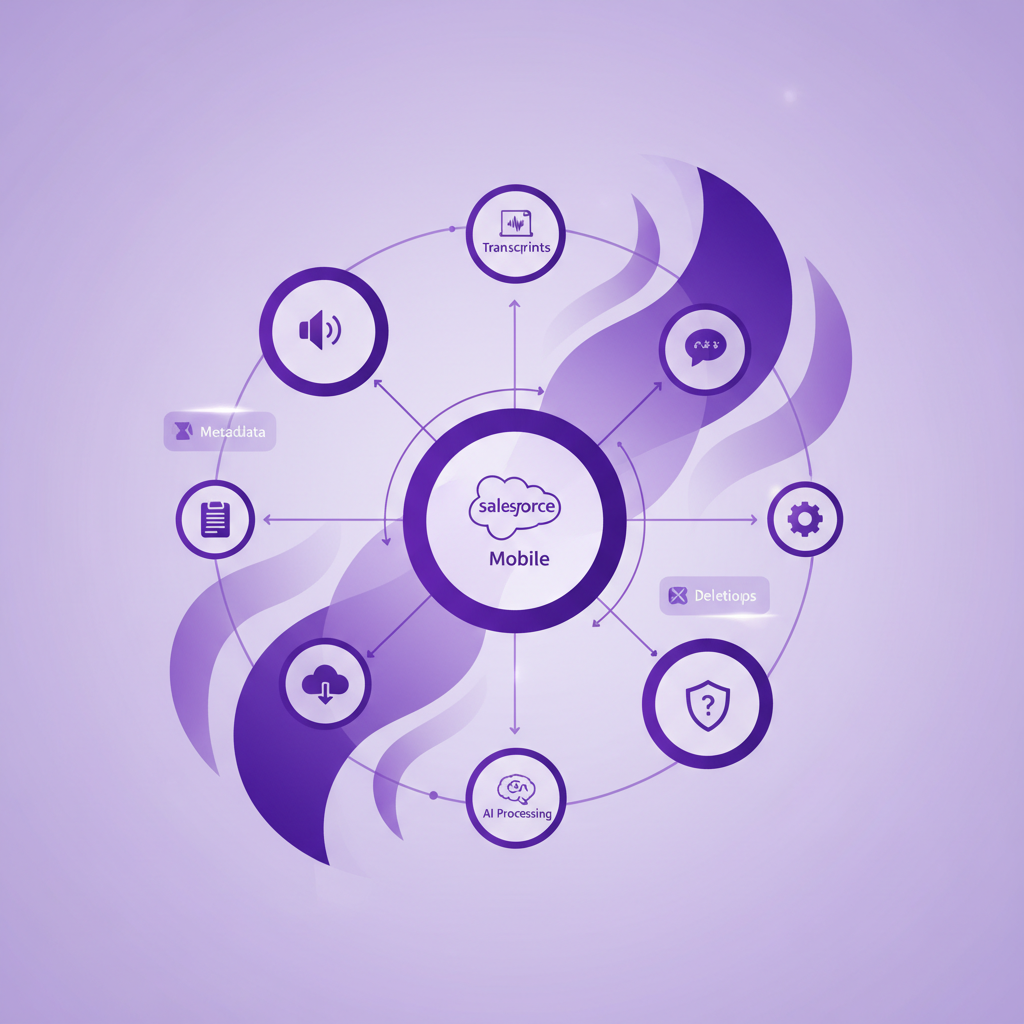
That data may include much more than the audio recording. A modern conversation intelligence workflow can produce:
- The audio file
- The transcript
- The AI summary
- Topics, sentiment, scores, and detected phrases
- Call metadata such as phone numbers, time, direction, and duration
- The matched Salesforce record
- Suggested next actions and field values
- Audit logs, backups, and diagnostic data
These components do not always share one location. A vendor may store recordings in one region, metadata in another, and derived AI data somewhere else. It may also use subprocessors for transcription, model inference, support, analytics, or backup services.
That is why a statement such as data is hosted in Europe is only the beginning of a useful answer.
Does Salesforce data residency cover connected call recordings?
Not necessarily.
Salesforce Hyperforce gives customers more choice and control over the region where applicable Salesforce data resides. Salesforce also provides tools for checking an org's instance and reviewing the relevant trust and compliance documents.
However, a connected telephony or mobile conversation platform can have its own architecture, contracts, subprocessors, storage regions, and support model. A link, activity record, or summary visible in Salesforce does not prove that every underlying artifact is stored within the Salesforce region.
The distinction depends on the implementation.
If the transcript and summary are written into standard Salesforce objects, those copies may follow the controls that apply to the org and service. If the recording player opens a file held by another provider, the audio may follow that provider's controls. If the integration keeps a copy of metadata for synchronisation or support, that copy may have another location and retention period.
The correct answer needs a data map, not an assumption based on the Salesforce screen.
Data residency, processing, access, and transfers are different questions
These terms are related, but they do not mean the same thing.
Data residency
Where is the data stored at rest?
Data processing
Where is the recording transcribed, summarised, analysed, indexed, backed up, or restored?
Data access
From which countries can authorised support, engineering, security, or customer personnel access the data?
International transfer
Which legal entities receive personal data across borders, and what safeguards apply?
Data retention
How long does each copy remain, and how is deletion applied to recordings, transcripts, summaries, backups, and logs?
A regional storage commitment can answer the first question without answering the other four.
The United Kingdom Information Commissioner's Office also makes an important distinction for cloud services. The location of a server alone does not determine whether a restricted transfer takes place. The legal entities involved, their locations, the processor relationship, and any subprocessors matter too.
This article is not legal advice. Your legal and data protection teams should interpret the applicable law and contracts. The operational job is to give them a complete, accurate picture of the service.
Why this matters more when mobile calls feed AI
A recording project used to create one obvious artifact: an audio file.
Conversation intelligence creates a much wider data chain. The audio may be transcribed. The transcript may be sent for summarisation. The summary may produce detected topics, action items, coaching signals, compliance flags, or suggested Salesforce updates. Search indexes and monitoring logs may help the service operate. Backups may preserve copies after the main record changes.
Each step can involve a different system or processor.
This does not make AI conversation intelligence inherently unsafe. It means the review must follow the entire workflow rather than stop at the recording location.
The distinction is especially important for mobile teams. Their calls may contain pricing, complaints, personal information, payment discussions, employment details, health information, financial circumstances, or commercially sensitive commitments. The conversation may start through an ordinary native mobile call, but the resulting data can travel through several services before Salesforce displays the final activity.
What should you ask a mobile call recording provider?
Use questions that require specific answers by data type, account type, and service date.
1. Where is each data type stored at rest?
Ask separately about audio, voicemail, transcripts, summaries, metadata, analytics, user data, support tickets, backups, and audit logs.
Do not accept one regional label as an answer for the complete service. Ask for a table that names each data type and location.
2. Does the answer apply to our existing account?
Regional hosting changes are often introduced for new customers first. Existing accounts may remain in an earlier region until a migration is available.
Confirm the answer for your actual tenant, not the vendor's newest default.
3. Can we choose or change the region?
Some services assign a region during account creation. Some allow a choice. Others require a migration project or do not support changes after setup.
This can affect procurement decisions, expansion into new markets, and future company restructuring.
4. Where does AI processing occur?
Ask where transcription, summarisation, classification, scoring, model inference, and human review take place.
Storage in one region does not prove that all processing remains there.
5. Which subprocessors receive conversation data?
Request the current subprocessor list and identify which providers handle recordings, transcripts, AI processing, hosting, monitoring, support, and backups.
For each one, ask what data it receives, why it receives it, where it is processed, and how long it remains.
6. Who can access the data from outside the storage region?
Support and engineering access may be necessary to operate the service. The useful question is how that access is approved, limited, logged, reviewed, and protected.
Ask whether access is routine, exceptional, or only customer authorised. Ask how privileged access is monitored.
7. What exactly is written into Salesforce?
Identify whether Salesforce stores the audio, a secure link, a transcript, a summary, metadata, a Task, another standard object, or a custom object.
Then identify which artifacts remain in the connected platform. This shows which controls belong to Salesforce and which belong to the provider.
8. What happens when data is deleted?
Ask how deletion affects the source recording, transcript, summary, search index, extracted fields, backups, support copies, and the Salesforce activity.
Deletion in one interface may not remove every derived or synchronised copy immediately.
9. Are customer conversations used to train shared models?
Ask whether recordings, transcripts, prompts, summaries, or feedback are used to train models that serve other customers. Get the answer in the contract or service terms, not only in a sales conversation.
10. How will we learn about a material change?
Hosting regions, subprocessors, and AI services can change. Confirm how the provider notifies customers, how much notice is given, and what options exist if a new arrangement conflicts with policy.
Build a conversation data map before approval
A practical data map can fit on one page. It should follow a representative mobile call through the service.
For every stage, record:
- The data created
- The system that receives it
- The legal entity providing the service
- The storage location
- The processing location
- The people or teams with access
- The Salesforce destination
- The retention period
- The deletion process
- The relevant contract or policy evidence
Run the map for an inbound call and an outbound call. Include a known Contact, an unknown number, a call linked to an Opportunity, and a call involving a Case. If different regions, teams, or policies apply, test those separately.
The goal is not to create a perfect architecture diagram. It is to expose gaps while they are still procurement questions rather than production surprises.
A seven step Salesforce verification workflow
1. Confirm the Salesforce org and service region
Use Salesforce's instance information and current trust documentation. Do not assume every connected service shares that region.
2. Inventory every conversation artifact
List audio, transcript, summary, metadata, AI outputs, links, tasks, files, logs, and backups.
3. Identify the system of storage for each artifact
Record whether the authoritative copy sits in Salesforce, the mobile conversation platform, a cloud storage service, or another processor.
4. Trace processing and support access
Document where AI processing occurs and which teams can access the data for operations or support.
5. Compare the design with company policy
Bring together legal, privacy, security, IT, Salesforce administration, compliance, and the business owner. Resolve conflicting requirements before rollout.
6. Test deletion and retrieval
Create test calls, find every resulting artifact, apply the documented deletion process, and verify what remains after the expected period.
7. Review the map when the service changes
Repeat the review when a new AI feature, subprocessor, region, Salesforce object, retention rule, or support model is introduced.
Common mistakes to avoid
Treating the Salesforce location as the whole answer
The org region matters, but connected call data may follow another architecture.
Treating regional storage as regional processing
Data at rest can stay in one region while authorised processing or support access occurs elsewhere.
Reviewing only the audio file
Transcripts, summaries, metadata, scores, and extracted actions can contain the same sensitive facts in more searchable forms.
Relying on a generic security page
Public documentation is useful, but procurement needs an answer for the exact product, account, region, features, and contract being purchased.
Forgetting existing customers
A new regional option may not apply to an older tenant without migration.
Leaving Salesforce administrators out of the review
Administrators can show where artifacts actually appear, which objects store copies, who can access them, and what automation creates further data.
Where RocketCell fits
RocketCell is built for Salesforce teams whose important customer conversations happen through ordinary mobile calling.
Using an eSIM or SIM based business mobile service, employees can make and receive native cellular calls through the familiar phone experience. Depending on configuration and company policy, RocketCell can bring the resulting call activity, recording, transcript, AI summary, record match, and suggested next action into the Salesforce workflow.
That solves an important capture problem, but data residency still deserves a precise implementation review. Customers should confirm the current storage, processing, access, subprocessor, retention, and deletion arrangements that apply to their chosen services and region.
RocketCell should be evaluated as part of the complete conversation data chain. The goal is a mobile workflow that employees will actually use and a governance model that legal, security, procurement, and Salesforce teams can explain with confidence.
Frequently asked questions
If our Salesforce org is in the United Kingdom, are all call recordings in the United Kingdom?
Not automatically. The answer depends on whether the recording is stored in Salesforce or by a connected provider, plus the region and terms that apply to that service.
Is data residency the same as data sovereignty?
No. Residency usually describes where data is stored. Sovereignty concerns the laws and legal authority that apply to data. Organisations should ask legal counsel to assess the relevant entities, jurisdictions, contracts, and transfers.
Does a recording link in Salesforce mean the audio is stored in Salesforce?
No. A Salesforce record can contain a secure link or player for audio stored elsewhere. Confirm the storage system for the underlying file.
Should transcripts and summaries follow the same rules as recordings?
They should be included in the same governance review. They may have different retention or access rules, but they can still contain personal, sensitive, and commercially important information.
Can regional storage remove the need for an international transfer review?
Not by itself. The legal entities, subprocessors, processing, and remote access arrangements also matter. The Information Commissioner's Office advises organisations to review the specific cloud provider relationship and safeguards.
How often should the data map be reviewed?
Review it at least when the provider, contract, region, AI feature, subprocessor, Salesforce integration, or retention policy changes. High risk environments may need a scheduled review as well.
The practical conclusion
Call recording data residency cannot be answered by pointing to one Salesforce region or one vendor data centre.
The reliable answer follows every artifact. It shows where the audio, transcript, summary, metadata, AI outputs, logs, and backups are stored, where they are processed, who can access them, how they reach Salesforce, and how they are deleted.
For mobile teams, this work supports two goals at once. Employees can keep using a natural cellular calling workflow, while the organisation keeps a clear account of what happens to the resulting conversation data.
That is the standard procurement, legal, security, and Salesforce teams should expect before a mobile call recording rollout moves into production.