
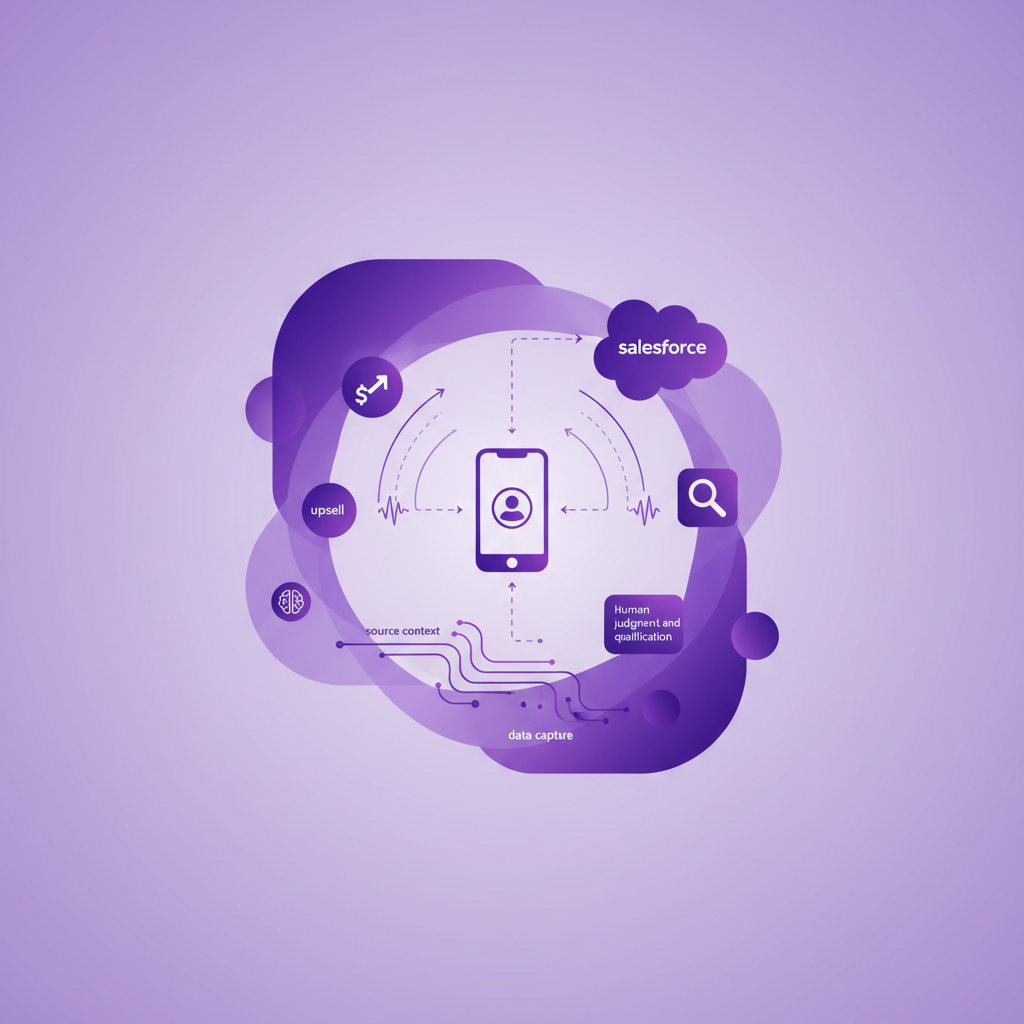
Customer Expansion Calls in Salesforce: How Mobile Teams Should Capture Upsell Signals
The most useful expansion signal is often not a score on a dashboard. It is a sentence a customer says during an ordinary call.
They are opening two new sites. They need more licences. Another team wants access. Their current process is reaching its limit. A project that was paused now has budget.
For account managers, these moments can lead to a relevant upsell or cross sell. But only if the conversation becomes usable account context. When the call happens on a mobile phone and the detail stays in the rep's memory, Salesforce cannot help the wider team evaluate the opportunity, prepare the right response, or follow through.
Customer expansion call capture means preserving the mobile conversation, matching it to the right Salesforce account, and recording enough evidence for a person to decide whether there is a real need worth pursuing. The goal is not to turn every positive comment into an Opportunity. It is to make genuine growth signals visible, reviewable, and actionable.
What is a customer expansion call in Salesforce?
A customer expansion call is a conversation with an existing customer that reveals a possible need for more value from the relationship. That might mean additional users, a larger deployment, a new product, wider geographic coverage, or a service that solves a newly discovered problem.
In Salesforce, the call should do more than appear as a timestamp. A useful record connects the conversation to the Account and relevant Contacts, preserves what the customer actually said, identifies the business context, and creates a clear next step when human review confirms that one is needed.
This is different from prospecting. The account already has history, stakeholders, products, service experiences, and commitments. A sensible expansion conversation must respect all of that context.
Why do mobile account calls create a blind spot?
Account managers do not spend every day inside a contact centre. They call customers from trains, client sites, hotel lobbies, and the car park after a meeting. Customers also call their direct business mobile numbers because that is the relationship they know.
Those conversations may contain better expansion evidence than a formal review meeting. The customer is speaking in the moment, often about an operational change that has not yet appeared in usage data or a renewal forecast.
If the call is not captured, several problems follow.
-
The signal depends on one person's memory.
-
The Opportunity may be created without the words and context that justified it.
-
Customer success, service, product, and sales teams may act on different versions of the story.
-
AI account briefings and recommendations operate on an incomplete interaction history.
-
A real need can disappear when the account owner is busy, absent, or reassigned.
The issue is not simply that Salesforce missed a call count. It missed the reason the account might be ready to grow.
Which customer statements can indicate expansion?
Expansion signals are usually expressions of change, friction, or ambition. Useful examples include:
-
A hiring plan that will require more seats or licences.
-
A new office, branch, site, territory, or country.
-
A second department asking to use the product or service.
-
A manual workaround that a related product could remove.
-
Capacity limits that are slowing the customer down.
-
A new compliance, reporting, or service requirement.
-
A merger, acquisition, funding event, or restructuring project.
-
Positive results that make the customer willing to broaden the rollout.
These are clues, not verdicts. The same sentence can mean different things in different accounts. Hiring may be approved or only discussed. A customer may mention a new site while also raising an unresolved service problem. A transcript can preserve the signal, but a person still needs to understand the relationship.
What should Salesforce capture after the call?
A useful customer expansion record needs a connected set of facts rather than one generic note.
The call identity
Capture who called, who answered, when the conversation happened, its direction, and its duration. Match the call to the correct Account and Contact wherever that match is reliable. If the number is unknown or relates to several records, preserve the uncertainty for review instead of forcing a confident link.
The source conversation
Where recording and transcription are appropriate under company policy and local rules, preserve the recording and transcript with controlled access. These are source materials. They let an authorised reviewer check the customer's wording and the context around it.
A concise summary
The summary should explain the customer's situation, the need they expressed, the relevant products or services, any timing mentioned, the people involved, and what was agreed. It should not make the opportunity sound more certain than the customer did.
The expansion signal
Record the type of potential need in a consistent way. A team might use categories such as additional users, new location, new department, new product, higher capacity, renewal change, or strategic project.
The category should help people find and group signals. It should not replace the source context.
The commercial context
Connect the signal to current products, contract dates, open Opportunities, active Cases, account health, key stakeholders, and any known blockers. Expansion activity should not ignore a serious service issue simply because the customer also mentioned growth.
The next action
Capture what happens next, who owns it, and when it is due. The correct action might be to arrange a discovery call, involve a specialist, confirm usage data, speak to procurement, update an account plan, or simply monitor the need until the timing is clearer.
Should every upsell signal create an Opportunity?
No. Creating an Opportunity automatically from every possible signal can fill the pipeline with weak records and make account teams less willing to trust the system.
A better process separates detection from qualification.
-
Capture the conversation and match it to the account.
-
Identify the possible expansion signal with the relevant excerpt and context.
-
Check whether the need is explicit, plausible, and connected to a problem the business can solve.
-
Review account health, current commitments, open service issues, stakeholders, timing, and budget evidence.
-
Decide whether to create or update an Opportunity, add the signal to an account plan, schedule discovery, or take no commercial action yet.
-
Preserve the decision so the same weak signal is not repeatedly rediscovered.
This approach gives AI a useful role without asking it to make the final commercial judgement. AI can find language, suggest a category, summarise the context, and propose a next step. The account owner remains responsible for deciding what the customer actually needs.
How should account teams handle conflicting signals?
Real customer conversations rarely fit into one neat category. A customer can be interested in expansion and unhappy with delivery at the same time. They can ask about a larger rollout while warning that budget approval is unlikely this quarter.
Salesforce should preserve both sides of the conversation.
An expansion signal should not erase a complaint, risk, objection, or support need. The next action may need to focus on resolution before selling. In some cases, the most commercially intelligent decision is to wait.
This is why the source conversation, account history, and human review matter. A positive phrase extracted without context can produce the wrong action and damage trust.
What should managers measure?
Managers need measures that reveal whether customer needs are being handled well, not just whether the system is producing more alerts.
Useful questions include:
-
What proportion of mobile account calls become matched Salesforce activity?
-
How many expansion signals are reviewed within the agreed time?
-
How many signals lead to discovery, an account plan update, or a qualified Opportunity?
-
How many are rejected because the need was weak, duplicated, mistimed, or contradicted by account risk?
-
Which customer needs recur across accounts?
-
Are follow up actions completed by the named owner?
-
Do created Opportunities retain a traceable link to the conversation that prompted them?
-
Are access, recording, transcription, and retention rules working as intended?
The aim is not to reward people for generating the most upsell flags. It is to help the business recognise relevant customer needs and respond with good judgement.
Where does RocketCell fit?
RocketCell is built for Salesforce teams whose account conversations happen through ordinary mobile calling. It captures business mobile calls through the cellular network and brings the resulting activity and conversation context into Salesforce without requiring the account manager to start every call in a separate calling app.
Depending on the customer's configuration and policy, that context can include call activity, a recording, transcript, AI summary, record matching, and suggested next actions. This gives Salesforce and downstream AI workflows a more complete view of the mobile conversations that shape renewals and account growth.
RocketCell does not decide whether a customer should be sold another product. It gives the account team a stronger conversation record from which to make that decision.
Questions to ask before rollout
Before using mobile calls to support customer expansion workflows, answer these questions:
-
Which account roles make or receive customer calls on ordinary mobile numbers?
-
How will calls be matched when one person relates to several accounts or Opportunities?
-
Which expansion signal categories are useful enough to act on?
-
What evidence must a reviewer see before creating an Opportunity?
-
How will open Cases, complaints, and account risks affect the next action?
-
Who reviews suggested signals and within what time?
-
Where will the source call, summary, decision, and follow up action live in Salesforce?
-
Which recording, transcription, access, and retention policies apply?
-
How will the team correct a wrong match or weak AI suggestion?
-
Which measures will show that the process improves customer relevance rather than pipeline noise?
Make customer growth signals visible before trying to automate them
Customer expansion depends on understanding how an existing customer's needs are changing. Mobile calls often reveal that change early, in the customer's own words.
When those conversations are captured and connected to the right Salesforce account, teams can review the evidence, coordinate a thoughtful response, and create an Opportunity only when the need is real. When the calls remain outside Salesforce, AI and automation are left to reason from an incomplete account history.
The practical order is simple: capture the mobile conversation, preserve the context, qualify the need, then act.