
First Call Resolution in Salesforce: Do Mobile Customer Calls Count?
First call resolution sounds like a simple service metric. A customer contacts the business, the team solves the issue, and the customer does not need to come back.
The calculation is simple too. Divide the number of issues resolved on the first contact by the total number of eligible issues, then multiply by 100.
The difficult part is deciding what counts as the first contact, what counts as resolution, and which later conversations belong to the same issue.
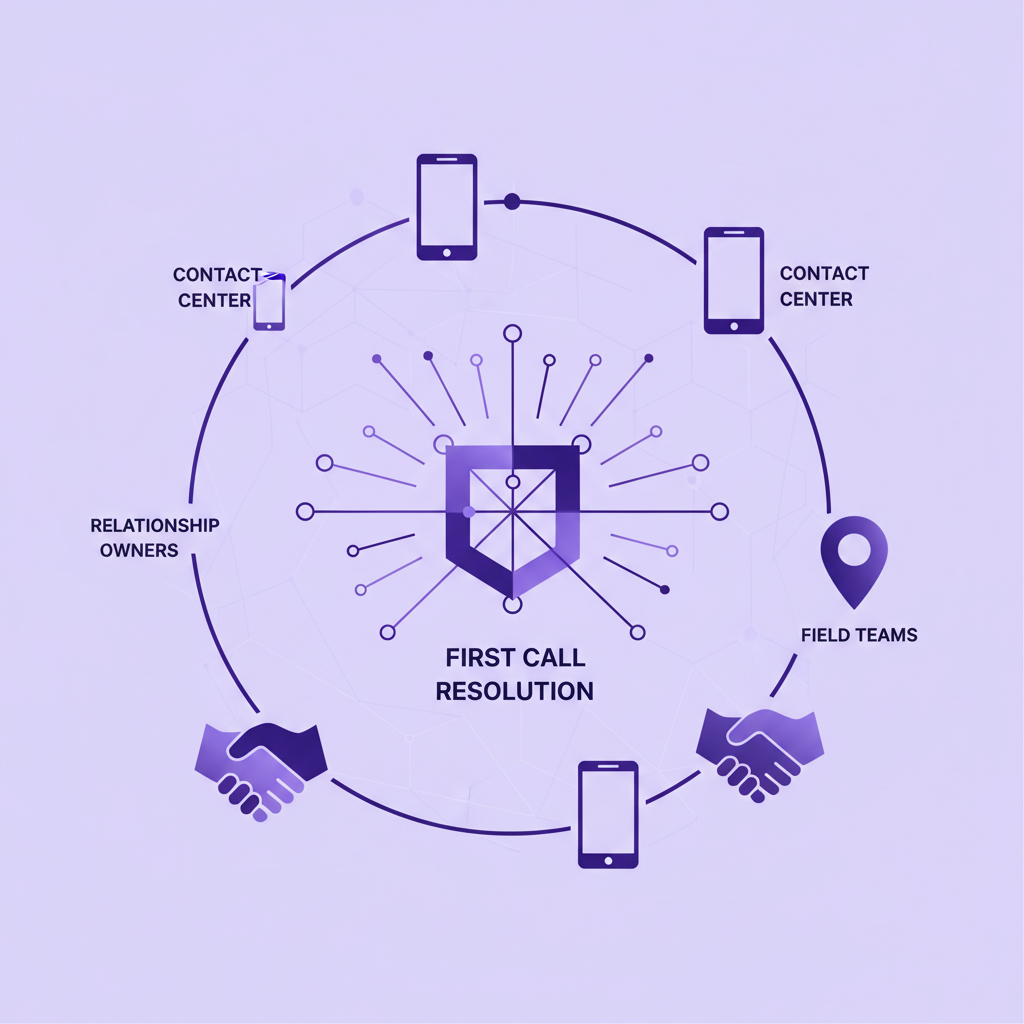
That gets harder when service leaves the contact centre. A customer might speak to an adviser, receive a mobile callback from an account manager, call a field engineer, or confirm the result with a regional service lead. If those ordinary mobile calls do not reach Salesforce, the dashboard can show a clean resolution while the customer is still chasing an answer.
For mobile service teams, first call resolution is only trustworthy when Salesforce can see the full issue journey.
What is first call resolution in Salesforce?
First call resolution, often shortened to FCR, is the percentage of eligible customer issues resolved during the first contact without another customer contact or required follow up about the same issue.
Some organisations use first contact resolution instead. That broader definition can include phone, email, messaging, chat, social, and other channels. Either term can work, but the measurement policy must say which channels and teams are included.
Salesforce can provide the customer, Case, activity, ownership, status, and timing data needed for FCR reporting. The metric is still only as complete as the interactions connected to that record.
If a customer calls the contact centre and later speaks to a field engineer on a normal mobile number, the second conversation matters. Leaving it out does not improve resolution. It only improves the reported number.
Why ordinary mobile calls create an FCR blind spot
Contact centre platforms are designed to measure interactions that pass through managed queues. Mobile work often follows a different path.
A service adviser may call from a business mobile after investigating the issue. An engineer may speak to the customer from site. A relationship manager may receive a direct callback because the customer trusts that person. A supervisor may use a mobile phone during an urgent escalation.
These are real service contacts, even when they do not pass through the original queue.
When the call is missing from Salesforce, several errors become possible:
-
A repeat contact looks like no repeat contact.
-
A promised callback is not counted as further work.
-
A Case appears resolved before the customer confirms the result.
-
A reopened issue looks like a new issue.
-
One team receives credit for resolution while another team does the work.
-
Managers investigate a poor customer score without seeing the conversation that explains it.
The core problem is not the FCR formula. It is incomplete conversation coverage.
Does a mobile callback mean the first call failed?
Sometimes. Not always.
The answer depends on the definition agreed before reporting begins.
If the first adviser promises to investigate and call back later, many organisations would treat the issue as unresolved on first contact because additional work was required. If the customer receives all necessary help during the first call and a later message simply confirms delivery, the original contact may still qualify.
A useful policy should distinguish at least four situations:
-
Resolved during the first conversation. The customer receives a complete answer or remedy and no further work is required.
-
Resolved with work after the conversation. The adviser owns an internal action that must happen before the customer has an answer. This usually should not count as first contact resolution.
-
Resolved after a customer callback. The customer contacts the business again about the same issue within the defined repeat window. This should not count as first contact resolution.
-
Confirmed after resolution. A later contact records satisfaction, delivery, or closure but does not continue the original problem. The organisation must decide whether this affects FCR and apply that rule consistently.
The policy matters more than choosing the most flattering interpretation.
What should Salesforce capture for reliable FCR reporting?
A reliable record needs more than a completed activity.
For each eligible issue, Salesforce should be able to show:
-
The customer and relevant account
-
The Case or other issue record
-
The time and channel of the first contact
-
The reason for contact
-
The product, service, order, site, or asset involved
-
The outcome described during the conversation
-
Any promised action, owner, and due time
-
Whether the customer appeared to confirm resolution
-
Any later contact about the same issue
-
The final resolution decision and who confirmed it
-
The source recording or transcript where policy and permissions allow
This creates an evidence chain. The call activity proves that contact happened. The transcript or recording can preserve what was said. The summary can make review faster. The Case status and FCR field record the organisation's confirmed operational decision.
Those are different layers and should not be collapsed into one AI generated answer.
How RocketCell helps mobile service conversations reach Salesforce
RocketCell helps organisations capture ordinary business mobile calls that would otherwise sit outside the Salesforce customer record.
Depending on configuration and company policy, a completed mobile call can be logged in Salesforce with the relevant call details, recording, transcript, summary, record match, and suggested next action. The user continues to call through the normal mobile experience.
For FCR reporting, that captured mobile conversation can help a service team answer practical questions:
-
Was there another call about the same issue?
-
Did the customer say the problem was solved?
-
Did the employee promise more work or another callback?
-
Was the call matched to the correct customer and Case?
-
Did the issue move between the contact centre, field team, and relationship owner?
RocketCell does not decide whether an issue is resolved, calculate the official FCR metric for every deployment, or replace Salesforce Service Cloud and contact centre reporting. Its role is to make the mobile conversation available so the organisation can apply its own resolution policy to better evidence.
A practical Salesforce workflow for mobile FCR
1. Define the unit of resolution
Decide whether FCR is measured by Case, customer issue, order, asset, service visit, or another business record. A phone number alone is not an issue identifier.
One customer can call twice on the same day about unrelated problems. Two people from the same account can contact different teams about the same outage. Your model must handle both.
2. Define eligible contacts
State which inbound and outbound contacts enter the calculation. Include the channels, teams, call paths, and Case types in scope.
If mobile callbacks are part of service delivery, include them in the measurement design even when the headline metric is called first call resolution.
3. Choose a repeat contact window
Set a period during which another contact about the same issue changes the result. The right window depends on the service.
A password reset may need only a short window. A repair, delivery, finance query, or complex equipment fault may need longer. Use a period that reflects when a customer would reasonably discover that the issue was not solved.
4. Capture the source conversation
Bring eligible contact centre and mobile calls into Salesforce. Preserve the source evidence allowed by your recording, access, and retention policies.
Do not assume that a completed Task proves resolution. It proves that an activity was completed.
5. Match the call to the right record
Connect the conversation to the correct Contact, Account, Case, and relevant commercial or service record.
Where matching is uncertain, preserve that uncertainty and route the record for review. A confident looking attachment to the wrong Case is worse than a visible exception.
6. Separate facts from interpretation
Keep the customer's words, the employee's notes, an AI generated summary, and the confirmed resolution status distinct.
AI can identify language such as "that has fixed it" or "I still cannot access the account." It can also miss context, humour, conditions, or a second unresolved request. Treat AI output as a review aid, not automatic proof.
7. Connect later contacts to the issue episode
Look for contacts within the repeat window that concern the same underlying issue. Phone number, Contact, Case, product, timing, reason, and transcript context can all help.
Do not merge unrelated contacts simply because they come from the same person. Do not split the same issue into new Cases merely to protect the metric.
8. Confirm the result
Define who can confirm FCR and when. That may be the adviser at the end of a clear interaction, a Case owner after checking for repeat contact, a quality team reviewing a sample, or a governed automation with exception rules.
Material or ambiguous cases should remain open to human review.
9. Report the reasons behind the number
The rate alone does not tell managers what to improve. Group failures by useful operational causes such as missing knowledge, unavailable stock, handoff failure, unclear ownership, system access, delayed approval, repeat fault, or poor record matching.
The most valuable question is not only "What is our FCR rate?" It is "Why did customers need to contact us again?"
Common FCR reporting mistakes
Treating Case closure as customer resolution
A closed Case is an internal status. It may reflect a real resolution, an administrative clean up, a duplicate record, or a premature closure. Compare the status with the source conversation and later contact history.
Ignoring outbound work
If an employee must call the customer later with the answer, the issue was not necessarily resolved during the first contact. Excluding outbound mobile callbacks can make the service operation look more effective than it was.
Counting every later call as a failure
Customers contact businesses for many reasons. A new order question should not overturn the resolution of yesterday's delivery query. Link contacts by issue, not just by identity.
Letting AI infer resolution from positive sentiment
A polite or cheerful customer can still have an unresolved problem. Sentiment is not resolution. Look for the requested outcome, remaining work, explicit conditions, and repeat behaviour.
Comparing teams with different definitions
One team may exclude transfers, another may include them, and a third may use a different repeat window. Standardise the policy before comparing performance.
Optimising the metric at the customer's expense
Pressure to protect FCR can encourage rushed calls, avoided follow up, or incorrect closure. Balance FCR with customer satisfaction, repeat contact rate, reopened Cases, quality review, complaint volume, and time to full resolution.
Questions to answer before rollout
-
Are we measuring first call resolution or first contact resolution?
-
Which mobile teams can continue or complete a service issue?
-
Do completed mobile calls reach Salesforce automatically?
-
What record represents one customer issue?
-
How long is the repeat contact window for each service type?
-
What counts as a confirmation contact rather than continued resolution work?
-
How will uncertain call matches be reviewed?
-
Which users may access recordings and transcripts?
-
Can a closed Case be overturned by a related later contact?
-
Who owns the final FCR decision?
-
Which failure reasons will managers review every month?
-
Which customer and quality measures will prevent unhealthy metric chasing?
Frequently asked questions
What is the formula for first call resolution?
Divide the number of eligible issues resolved on the first contact by the total number of eligible issues, then multiply by 100. The formula is simple, but the definition of eligible, first contact, same issue, repeat window, and resolution must be documented.
Should mobile callbacks count in FCR?
Yes, when the callback continues work needed to solve the original issue. A confirmation call after a complete resolution may be treated differently, but the rule should be explicit and consistent.
Can Salesforce measure first call resolution?
Salesforce can hold the customer, Case, activity, timing, channel, outcome, and status data needed for FCR reporting. Reliable measurement depends on capturing all relevant interactions and connecting them to the same issue episode.
Can AI decide whether a customer issue was resolved?
AI can identify possible resolution language, promised actions, and unresolved questions. It should not be treated as unquestionable proof. Important or ambiguous outcomes need defined controls and human review.
Is a closed Case the same as first call resolution?
No. Case closure is an internal status. First call resolution asks whether the customer's issue was solved during the first eligible contact without required further work or repeat contact under the organisation's policy.
How does RocketCell support FCR reporting?
RocketCell helps bring ordinary business mobile calls into Salesforce with conversation context where configured. That can give service teams a more complete record of callbacks, field conversations, customer confirmations, and unresolved work before they calculate or review FCR.
The practical takeaway
First call resolution is not trustworthy if the service journey continues on mobile phones that Salesforce cannot see.
Start with a clear measurement policy. Define the issue, the eligible channels, the repeat window, and the evidence required for resolution. Capture the mobile calls that continue or complete the work. Match them to the right customer and Case. Keep source facts, AI suggestions, and confirmed status separate.
RocketCell helps make ordinary mobile service conversations visible in Salesforce. Your service policy still decides what resolved really means.