
How to Capture MEDDICC Evidence From Mobile Sales Calls in Salesforce
An account executive leaves a customer site and takes a call in the car park. During ten minutes of ordinary conversation, the buyer explains who controls the budget, which security review comes next, why the current process is failing, and who can build internal support.
The Opportunity in Salesforce still says only “Discovery complete.”
This is a common qualification gap. The team may use MEDDICC consistently in deal reviews, yet some of the best evidence never reaches the fields, notes, and records that managers inspect. It stays in a mobile call, in the seller’s memory, or in a brief update written hours later.
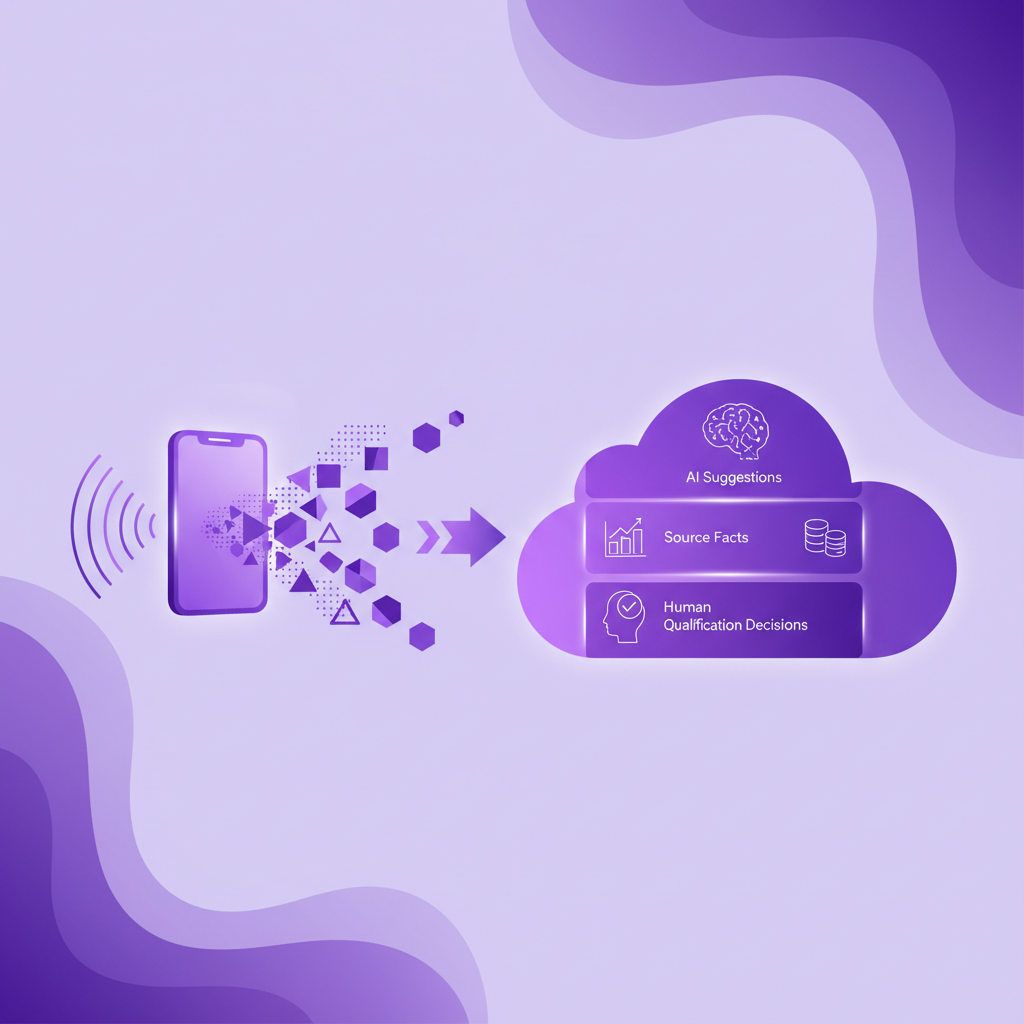
The answer is not to let AI qualify the deal on its own. It is to capture the source conversation, extract useful evidence, and give the right person a clear way to confirm what Salesforce should record.
What is MEDDICC evidence?
MEDDICC evidence is information from the buyer and the buying process that supports one or more parts of the qualification framework: Metrics, Economic buyer, Decision criteria, Decision process, Identify pain, Champion, and Competition.
Some organisations use MEDDIC without Competition. Others add Paper process and call the framework MEDDPICC. The operating principle is the same. A completed field is not enough. The sales team needs to know what supports it, when that evidence was gathered, and whether it is still current.
A useful Salesforce record should therefore separate three things:
- The source fact, such as a buyer statement in a captured conversation
- The interpretation, such as an AI suggestion or a seller’s qualification note
- The confirmed status the sales organisation uses in reviews and forecasts
That distinction matters because a confident summary can still be wrong. A contact who discusses budget may not be the Economic buyer. A friendly supporter may not be a Champion. A target date may be an aspiration rather than an approved Decision process.
Why mobile sales calls create a MEDDICC blind spot
Complex deals rarely unfold in one scheduled video meeting. Buyers call sellers directly after internal discussions. Champions share candid information while travelling. A procurement contact returns a call between meetings. An executive gives a short answer from a mobile phone because there is no time for another calendar invitation.
These calls can contain better qualification evidence than a formal meeting because the conversation is immediate and specific. They are also easy to lose.
If a seller has to open a separate calling app, remember every detail, and update several Salesforce fields later, data quality depends on perfect behaviour at the busiest point in the day. A short note may preserve the conclusion while losing the buyer’s exact language, the surrounding uncertainty, and the agreed next step.
For MEDDICC, that loss is important. Qualification is not a one time form. Evidence develops, changes, and sometimes becomes weaker as a deal moves forward.
What should a mobile call capture for each MEDDICC category?
The goal is not to force every conversation through a checklist. Good discovery still sounds like a conversation. The goal is to recognise useful evidence when it appears and connect it to the Opportunity in a form that can be reviewed.
Metrics
Metrics describe the measurable result the buyer wants. Strong evidence includes the current baseline, the desired improvement, the unit of measurement, the person who owns it, and the period in which the change matters.
“We need to save time” is a theme. “The service team spends 18 hours each week rebuilding mobile call notes, and the operations director wants that below five hours before the new region opens” is qualification evidence.
Salesforce should preserve the buyer’s stated numbers separately from any return calculation produced by the seller. Assumptions, ranges, and estimates should be labelled clearly.
Economic buyer
The Economic buyer is the person, or sometimes the group, with authority over the financial decision. A job title alone does not prove that authority.
A mobile conversation might reveal who owns the budget, who can approve an exception, whether approval is individual or collective, and how the seller can reach that person. The record should show what the contact actually said and whether the sales team has confirmed access.
This prevents a familiar problem: Salesforce names an Economic buyer because someone is senior, while the real approval sits elsewhere.
Decision criteria
Decision criteria are the standards the buyer will use to compare choices. They may include commercial value, security, integration, implementation effort, user adoption, service coverage, or regulatory requirements.
Useful call evidence identifies which criteria are mandatory, which are preferences, who owns each one, and how the buyer will assess them. It should also record changes. A technical criterion introduced late in the process can matter more than a longer list gathered during early discovery.
Decision process
Decision process evidence explains how the organisation will reach a decision. It includes steps, stakeholders, dependencies, meetings, approval points, dates, and the conditions that can stop progress.
A statement such as “legal is next” is too vague for reliable planning. Better evidence names the review, the owner, the expected timing, what must be submitted, and what happens after approval.
The process should be based on the buyer’s actions, not only the seller’s sales stages.
Identify pain
Pain is the business problem the buyer is motivated to solve. Strong evidence connects the current situation to operational, financial, customer, or personal consequences.
A transcript may contain several complaints, but not every complaint is material. The seller should confirm which problem matters, who feels it, what happens if it continues, and why action is needed now.
AI can help locate relevant moments. It should not decide that a passing frustration is a qualified business pain.
Champion
A Champion has influence and actively helps the buying process. Enthusiasm is not enough.
Evidence of a Champion can include arranging access to stakeholders, explaining internal politics, testing the business case, correcting the seller’s assumptions, or helping the team navigate the Decision process.
Salesforce should capture observable actions as well as the seller’s assessment. That makes Champion status easier to review and less dependent on optimism.
Competition
Competition includes named vendors, internal alternatives, delay, and the decision to keep the current approach. It is often disclosed in fragments across several conversations.
Useful evidence identifies the alternative, why it is credible, which criterion it satisfies, who supports it, and when the comparison will be resolved. The status quo deserves particular attention because it can win without appearing in a formal shortlist.
What should Salesforce store after the call?
A complete MEDDICC workflow needs more than a populated score.
- The call activity, including time, direction, duration, and participants
- The Salesforce record match and any uncertainty about that match
- The recording where it is configured, permitted, and appropriate
- The transcript where transcription is enabled
- A concise summary of the conversation
- Candidate MEDDICC evidence linked to the relevant category
- The source passage or timestamp that supports each important suggestion
- A confirmation status showing whether the evidence is suggested, reviewed, confirmed, contradicted, or no longer current
- The owner and date for the next action
- The date on which each qualification item was last confirmed
This structure gives a manager a path back to the source without turning every pipeline review into a replay of the entire call.
A practical workflow for mobile call evidence
Step 1: Define what good evidence means
Agree on the standard for each MEDDICC category before adding automation. Define what counts as confirmed, what remains uncertain, and which fields affect forecasting or stage progression.
Step 2: Capture ordinary business mobile calls
Make sure the calls that happen through normal mobile behaviour can reach Salesforce. Planned outbound calls, direct inbound calls, and customer callbacks can all contain qualification evidence.
Step 3: Match the conversation to the right record
Connect the call to the correct Contact, Account, and Opportunity where possible. When the number is shared, unknown, or linked to several records, send it for review instead of making a silent assumption.
Step 4: Preserve the source
Retain the call record and, where company policy permits, the recording and transcript. Apply appropriate access, consent, and retention controls. The source is what allows a later reviewer to distinguish a buyer statement from a generated interpretation.
Step 5: Extract candidate evidence
Use AI to identify possible Metrics, stakeholders, criteria, process steps, pain, Champion actions, competitors, and dates. Present these as suggestions with supporting context.
Step 6: Ask a human to confirm material updates
The Opportunity owner, manager, or another authorised reviewer should confirm important changes. This is especially important for Economic buyer status, Champion strength, forecast relevant dates, commercial values, and any field that can trigger an external action.
Step 7: Record uncertainty honestly
Allow values such as unknown, unconfirmed, conflicting, and changed. Empty confidence is more useful than false certainty. It tells the seller what to discover next.
Step 8: Make the next action specific
Every meaningful gap should lead to an accountable action. Name the owner, due date, and intended result. “Confirm security approval owner with Priya by Thursday” is more useful than “follow up.”
Step 9: Review evidence over time
Qualification decays. Budget owners change. Criteria expand. Champions lose influence. Dates move. A current Opportunity view should show when evidence was last confirmed and which call introduced the change.
MEDDICC fields should not become a scorekeeping exercise
Automation makes it tempting to convert every transcript into a score and every score into a forecast conclusion. That can create neat dashboards without improving the quality of the deal.
MEDDICC is valuable because it prompts better investigation. It is not a substitute for commercial judgement. A call can provide strong evidence in one category and create new uncertainty in another. A complete set of fields can still describe a weak deal. An incomplete set can reveal exactly where the next conversation should focus.
Managers should review the quality, freshness, and source of the evidence, not simply count populated boxes.
Useful questions include:
- Which qualification claims came directly from the buyer?
- Which claims are seller interpretations or AI suggestions?
- When was each material point last confirmed?
- What changed in the most recent conversation?
- Which claim has conflicting evidence?
- What is the next action that will reduce uncertainty?
How RocketCell supports MEDDICC workflows in Salesforce
RocketCell is a business mobile network for Salesforce. Employees can make and receive ordinary cellular calls through an eSIM or SIM while the business captures mobile call activity in Salesforce.
Depending on the organisation’s configuration and policy, the resulting record can include call details, recording access, a transcript, an AI summary, record matching, and suggested next actions. Those inputs can support a MEDDICC workflow because the mobile conversation becomes available where the Opportunity is managed.
RocketCell does not decide whether a deal is qualified. It does not prove that a contact is the Economic buyer or that a supporter is a Champion. It provides the missing mobile conversation layer so sellers, managers, and governed Salesforce workflows can make those decisions from better evidence.
Frequently asked questions
Can AI update MEDDICC fields from a call transcript?
AI can identify candidate evidence and prepare suggested field updates. Material qualification decisions should still follow the organisation’s review rules, particularly when the source is ambiguous or the update affects forecasting, stage progression, or external communication.
Should every call update every MEDDICC category?
No. Most calls will strengthen, weaken, or change only part of the qualification picture. Forcing every category into every summary encourages invented certainty and repetitive notes.
Is a call summary enough for a MEDDICC review?
Usually not. A summary is useful for orientation, but important claims should remain traceable to the source conversation. The reviewer should also be able to see when the evidence was gathered and whether a person confirmed it.
What if a mobile number matches more than one Salesforce record?
The workflow should expose the ambiguity and request review. A confident summary attached to the wrong Contact or Opportunity can be more damaging than a missing update.
Does MEDDICC replace Opportunity stages?
No. MEDDICC is a qualification framework. Opportunity stages represent the organisation’s sales process. The two can inform each other, but a completed qualification field does not automatically prove that a stage exit criterion has been met.
Turn mobile conversations into reviewable qualification evidence
The strongest MEDDICC process is not the one with the most completed fields. It is the one that helps the team understand what the buyer has confirmed, what remains uncertain, and what must happen next.
For mobile sales teams, that starts with visibility. When ordinary business calls reach Salesforce with their source context intact, qualification can rely less on memory and more on reviewable evidence.
RocketCell helps make those conversations available to the people and workflows responsible for the deal. That gives MEDDICC a stronger foundation without asking AI to make the commercial decision.