
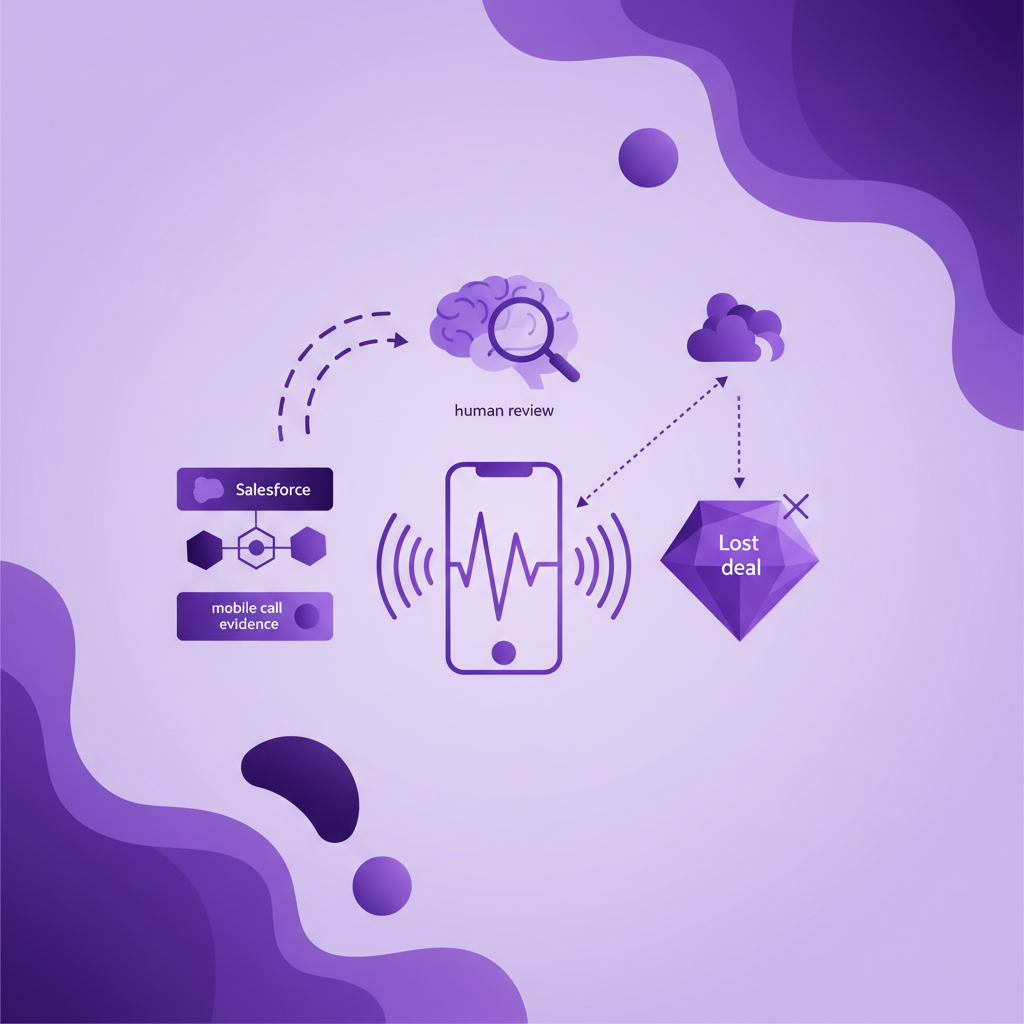
Lost Deal Analysis in Salesforce: What Mobile Calls Reveal Beyond Close Reasons
Every lost Opportunity in Salesforce usually ends with a tidy answer.
Price. Timing. Competitor. No decision. Budget.
Those labels help with reporting, but they rarely explain why the deal was lost. A required Close Reason field records the final category someone selected. It does not preserve the customer conversation that led to that conclusion.
For mobile sales teams, the gap can be even wider. The decisive call may happen while a rep is travelling, leaving a customer site, or answering a direct callback. If that ordinary mobile conversation never reaches Salesforce, the business is left with a picklist value and a story reconstructed from memory.
Lost deal analysis in Salesforce should connect the selected Close Reason to the source conversations, customer language, timeline, stakeholders, objections, commitments, and follow up that shaped the outcome. The purpose is not to challenge every rep or let AI rewrite the result. It is to understand what actually happened well enough to improve the next deal.
What is lost deal analysis in Salesforce?
Lost deal analysis is the process of reviewing why an Opportunity did not progress and using that evidence to improve sales decisions, coaching, product feedback, pricing, qualification, and customer follow through.
In Salesforce, a useful lost deal review should combine structured fields with conversation context. The Close Reason gives the business a consistent reporting category. The call record, transcript, summary, outcome, timeline, and next steps explain the sequence behind it.
Both matter. Without a structured reason, reporting becomes inconsistent. Without the conversation evidence, a clean dashboard can hide a weak explanation.
Why is a Close Reason field not enough?
A Close Reason field compresses a complicated buying decision into one label. That is useful for counting outcomes, but it creates several limits.
First, one deal can have several causes. Budget may have been the final obstacle, but the customer may also have lacked an internal sponsor, doubted the implementation plan, and delayed security review.
Second, the selected reason may reflect the last conversation rather than the whole deal. A competitor can win at the end of a process that was already weakened by slow follow through months earlier.
Third, different reps can interpret the same picklist values differently. One person chooses Timing when the buyer delays. Another chooses No decision. A third chooses Budget because funding was not approved.
Fourth, the field usually records the seller's conclusion. It may not preserve the customer's exact words or the uncertainty around them.
A Close Reason should be treated as an index into the story, not the story itself.
Why do mobile calls matter in a lost deal review?
Formal demos and scheduled meetings often produce clean records. The calls that reveal doubt can be less organised.
A prospect rings the account executive after an internal meeting. A champion calls from a train to explain that procurement has changed the process. A decision maker returns a missed call and says the project will not receive approval this quarter. A rep speaks to the buyer immediately after a competitor presentation.
These moments often contain candid information because the conversation is direct and timely. They can reveal who objected, which requirement mattered, what changed, and whether the deal is truly lost or simply mistimed.
If the call remains on the handset, Salesforce may show activity silence just before the Opportunity closes. Managers then review the result using notes written later, a summary from a different meeting, or the final Close Reason alone.
The missing call does not just reduce activity data. It removes the evidence that could explain the loss.
What should Salesforce preserve for each lost deal?
A practical review needs connected evidence rather than a larger pile of notes.
1. The Opportunity decision
Record the stage change, Close Reason, decision date, amount, products, forecast history, and owner. Preserve who changed the record and when. This creates the formal outcome that reporting needs.
2. The relevant conversations
Link the mobile calls, meetings, emails, and other meaningful interactions that influenced the decision. The goal is not to attach every activity ever created. It is to make the decisive sequence visible.
3. The source context
Where recording and transcription are appropriate under company policy and local rules, preserve controlled access to the recording and transcript. These source materials help an authorised reviewer check wording, tone, questions, commitments, and uncertainty.
4. The summary and outcome
Add a concise account of what the customer said, what the rep understood, what was agreed, and what happened next. Keep facts separate from interpretation. If the buyer did not give a definite reason, the record should say so.
5. The buying group
Identify the champion, decision maker, procurement contact, technical reviewer, finance stakeholder, and any person who entered the deal late. Many losses make more sense when the team can see whose concerns were heard and whose were missed.
6. The turning point
Mark the event that materially changed the deal. It might be a security objection, a missed deadline, a new competitor, an unresolved service concern, a budget freeze, a leadership change, or a discovery gap that appeared too late.
7. The future path
Record whether the account should be nurtured, revisited on a specific date, excluded from immediate outreach, or handed to another team. A lost deal can still contain a useful next action, but that action should reflect what the customer actually requested.
Which questions should a lost deal review answer?
A good review moves beyond asking why the rep selected a particular field value.
-
What problem was the customer originally trying to solve?
-
Did that problem remain important through the final conversation?
-
Who supported the purchase and who could block it?
-
Which customer statements support the selected Close Reason?
-
Were several causes present, and which one became decisive?
-
Did the team discover budget, authority, timing, technical, legal, or procurement constraints early enough?
-
Were promised actions completed when the customer expected them?
-
Did an ordinary mobile call reveal a change that never reached the Opportunity record?
-
Was the competitor chosen because of product fit, existing relationship, commercial terms, delivery confidence, or a simpler buying process?
-
Is the Opportunity truly lost, or does the evidence support a specific future review date?
These questions make the review useful to sales leaders, RevOps, enablement, product, and account teams without turning it into a search for blame.
How should AI support lost deal analysis?
AI can help a reviewer find patterns across more conversations than a person could listen to manually. It can locate objection language, group recurring themes, compare the selected Close Reason with call context, summarise a timeline, and suggest where evidence is missing.
It should not quietly replace the formal reason, invent certainty, or decide that a rep caused the loss.
A sensible workflow separates four layers.
-
Source evidence includes the captured call, transcript, activity data, and customer statements.
-
AI interpretation includes proposed themes, summaries, turning points, and possible inconsistencies.
-
Human judgement confirms what the business believes happened and whether the Salesforce record needs correction.
-
Business action decides what changes in coaching, process, product feedback, qualification, or future account contact.
This separation matters because a transcript can be incomplete, a speaker can be misunderstood, and a customer can give a polite reason that is not the whole reason. AI can make review faster. It cannot make uncertainty disappear.
How can RevOps improve Close Reason data?
Better lost deal analysis does not require dozens of new fields. It requires clearer definitions and stronger links between the label and the evidence.
Start with a short set of Close Reasons that people can distinguish consistently. Give each reason a plain definition and examples. Allow a secondary factor when one category cannot represent the decision. Add a confidence or review state when the customer did not confirm the reason directly.
Then connect the field to the relevant conversation record. A reviewer should be able to move from the Opportunity outcome to the mobile call, transcript, summary, and timeline that support it without searching across personal notes and phone histories.
Finally, review patterns over time. Look for reasons that are used too broadly, teams that interpret categories differently, frequent late stage surprises, and losses where the final customer call was missing. The aim is not perfect taxonomy. It is a more honest and useful picture of how deals end.
What should managers measure?
The most useful measures test the quality of the learning process.
-
What proportion of Closed Lost Opportunities have a clear, evidence supported reason?
-
How many decisive mobile calls are matched to the correct Opportunity or Account?
-
How often does review confirm the original Close Reason?
-
Which secondary factors appear most often alongside the main reason?
-
How many losses contain a missed commitment or late discovery that the team can address?
-
Which themes repeat by segment, product, region, deal size, or sales stage?
-
How many future review tasks are completed at the time agreed with the customer?
-
Are insights leading to specific changes in coaching, qualification, enablement, product decisions, or process?
Do not measure success by the number of themes an AI system produces. Measure whether the business understands losses earlier and makes better decisions as a result.
Where does RocketCell fit?
RocketCell is built for Salesforce teams whose important customer conversations happen through ordinary mobile calling. It captures business mobile calls through the cellular network and brings the resulting activity and conversation context into Salesforce without requiring the rep to begin every call in a separate calling app.
Depending on the customer's configuration and policy, that context can include call activity, recording, transcript, AI summary, record matching, and suggested next actions. This helps preserve the mobile conversations that explain why an Opportunity progressed, stalled, or closed.
RocketCell does not decide why a deal was lost. It helps Salesforce retain a stronger source record so managers, RevOps teams, and sellers can make that judgement with more complete evidence.
Questions to ask before rollout
Before building a lost deal analysis workflow around mobile call data, answer these questions.
-
Which calls are currently missing when reps use normal mobile behaviour?
-
How will mobile calls be matched to the right Opportunity, Account, and Contact?
-
Which Close Reasons are clear enough for consistent use?
-
How will the business record secondary causes and uncertainty?
-
Which conversations should be linked to the final decision?
-
Who can access recordings and transcripts where they are enabled?
-
Who reviews a possible mismatch between the selected reason and the conversation evidence?
-
How can a rep correct an inaccurate AI interpretation?
-
Which future contact promises should create an owned Salesforce task?
-
How will recurring findings reach enablement, product, pricing, and leadership teams?
Make the reason traceable to the conversation
A Close Reason is useful because it makes reporting consistent. It becomes much more valuable when the business can trace it back to the conversations that shaped the decision.
For mobile teams, that means capturing the ordinary calls where customers explain what changed, what worried them, who objected, and whether the door is still open. With that context in Salesforce, a lost deal review can move beyond counting labels and start producing useful learning.
The practical order is simple. Capture the conversation. Preserve the evidence. Confirm the reason. Then decide what the business should learn and do next.