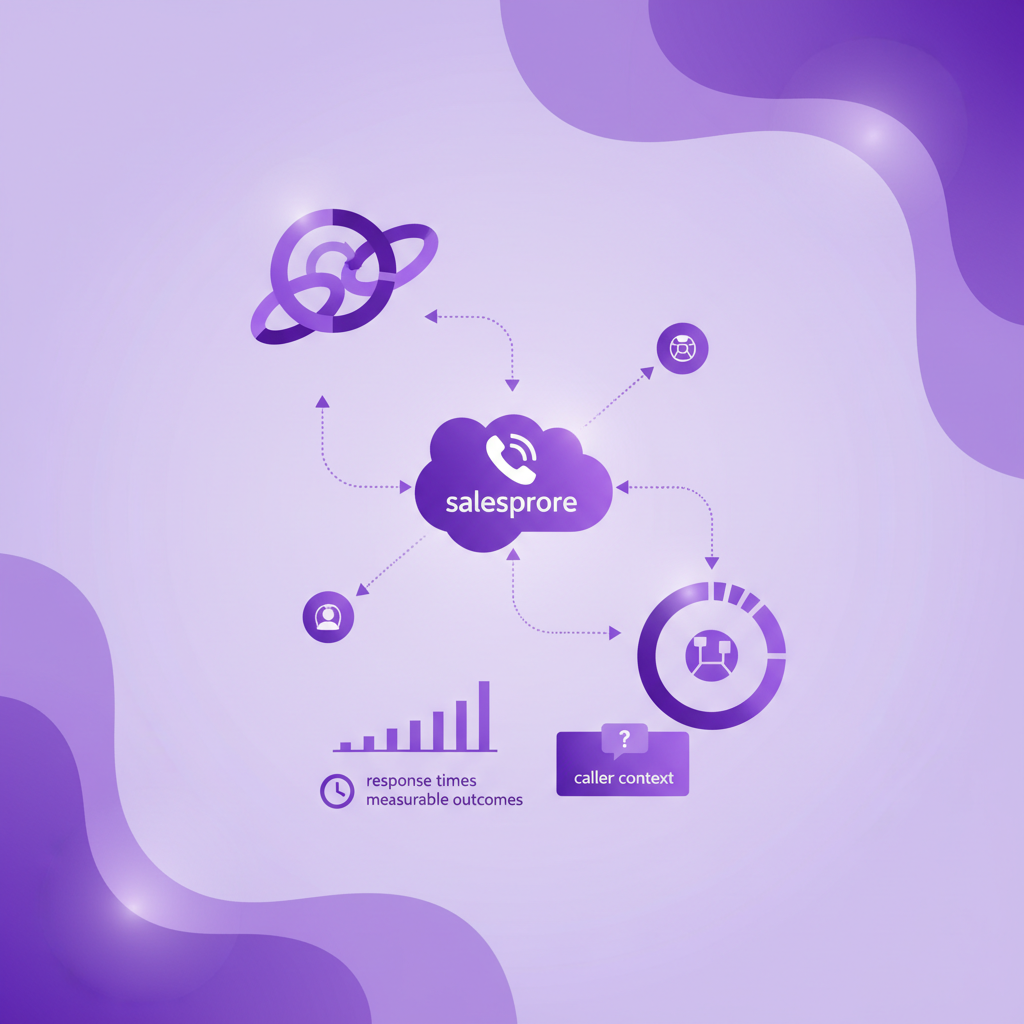
A missed mobile call should not end as a notification on one employee's phone. It should become a visible Salesforce event with a clear owner, a response deadline, enough caller context to act safely, and a final outcome that closes the loop.
That sounds obvious. In practice, many Salesforce teams only have a reliable process for calls that begin inside a contact centre, softphone, or sales engagement platform. Field reps, account managers, recruiters, and service teams often receive direct calls on ordinary business mobile numbers. If the employee cannot answer, the customer intent may remain trapped in the phone's recent call list.
The real question is not whether the phone displayed a missed call. It is whether the business created an accountable callback workflow.
What is a missed mobile call in Salesforce?
A missed mobile call is an inbound call to a business mobile number that was not answered by the intended employee and needs a recorded decision about what happens next.
In Salesforce, the useful record is more than a timestamp and a phone number. It should show whether the caller could be matched to an existing record, who owns the response, when the callback is due, whether contact was made, and what happened when the conversation eventually took place.
This distinction matters because a missed call event is not yet a customer conversation. There is no recording, transcript, or AI summary of a conversation that never happened. There is only an attempt to connect, some identity evidence, and a responsibility to respond.
Good automation respects that boundary.
A missed ring is not always a missed customer call
Before creating Salesforce tasks, teams need a precise definition of missed.
In a call queue, one customer call might ring several employees before somebody answers. If every failed ring creates a separate callback task, Salesforce can show four missed calls even though the customer spoke to the fifth person. That creates duplicate work and a poor customer experience.
Direct mobile calling has a different shape. A customer may call one account manager's business mobile number because that is the relationship they know. If the account manager does not answer, there may be no queue, shared inbox, or contact centre agent to recover the call.
Salesforce reporting should therefore separate at least three events:
-
A ring attempt to an individual user.
-
A customer call that nobody answered.
-
A completed callback that resolved or advanced the original request.
Without that separation, managers can mistake routing noise for customer demand. Reps can also call somebody back after a colleague has already handled the issue.
What should Salesforce create after a missed mobile call?
The exact object model depends on the organisation. Some teams use Tasks. Others use a specialised voice object, a Case, a Lead, or a custom callback record. The object matters less than the operating discipline around it.
A useful missed call record should contain the following information.
Call event
Salesforce should receive the inbound direction, business mobile number called, caller number when available, time of the attempt, intended user, and call status.
The status should make it clear that no conversation occurred. A zero duration event, a voicemail, a rejected call, and a network failure may need different handling.
Caller context
The phone number should be checked against relevant Salesforce records. A confident match can give the owner useful context such as the Account, open Opportunity, active Case, recent activity, or agreed next step.
An ambiguous match should remain ambiguous. If one number appears on several records, automation should not quietly choose the most convenient one and treat it as fact.
An unknown caller should not automatically become a new Lead in every situation. The number may belong to an existing customer whose details are stored differently, a shared switchboard, a family member calling for a client, or a person whose record has not yet been cleaned up. Creating a review queue can be safer than creating duplicate data.
Callback ownership
Every actionable missed call needs one named owner. That may be the employee who was called, the current Account owner, the Case owner, a territory queue, or a duty team.
Ownership rules should reflect the business relationship. A service escalation should not wait in a sales rep's personal task list simply because the customer called that rep first. Equally, a strategic account callback should not move to a generic queue if the named account manager has the context and availability to respond.
Response expectation
The callback record should have a due time or service expectation. A task marked open with no deadline is easy to ignore and difficult to manage.
Different calls may need different priorities. An existing customer with an active Case may require faster review than an unknown number with no voicemail. A call received outside business hours may start its response window when the team returns, depending on policy.
Closure evidence
The workflow should not close merely because somebody pressed the call button. It should record whether the caller answered, whether another attempt is due, whether the matter moved to another channel, or whether the callback produced a completed conversation.
When the callback connects, Salesforce can then hold the richer context that belongs to an actual conversation, including the recording, transcript, summary, outcome, and next action where those features are configured and permitted.
Who should own the callback?
There is no single rule that works for every team, but there should be a deterministic rule that people understand.
The person who received the call
This works when customers have direct relationships with individual reps and coverage is simple. It preserves continuity, but it becomes fragile during leave, travel, meetings, or employee departures.
The Salesforce record owner
This can work well for Account, Lead, Opportunity, or Case based teams. It keeps responsibility aligned with the CRM, although record ownership is not always the same as day to day relationship ownership.
A shared queue
A queue is useful when speed matters more than personal continuity. Service desks, recruitment teams, and regional sales groups can route missed calls to the first available qualified person. The queue still needs safeguards so two people do not return the same call.
A rule based owner
More mature teams can use caller identity, Account tier, open Case status, territory, language, working hours, or previous activity to assign the task. The logic should be reviewable and should preserve uncertainty when Salesforce cannot identify the caller confidently.
The best rule is the one that produces one accountable owner without hiding the context other people need.
A practical Salesforce callback workflow
A reliable workflow can be designed in seven stages.
-
Capture the unanswered inbound call event from the approved business calling setup.
-
Check whether the customer call was truly unanswered, rather than one ring attempt inside a call that somebody else handled.
-
Match the caller to Salesforce with a confidence level and preserve any ambiguity.
-
Create one callback record with an owner, priority, due time, and source event.
-
Show the owner relevant context such as recent calls, open Opportunities, active Cases, and previous promises.
-
Record each response attempt without creating a fresh chain of unrelated tasks.
-
Close the callback only with a clear outcome and a next action when one is still required.
This gives Salesforce a connected history: the original attempt, the ownership decision, the response, and the eventual business outcome.
What should managers report on?
Call volume alone does not show whether a callback process works. Managers need measures that reveal customer demand and operational accountability.
Useful Salesforce reporting can include:
-
Unique unanswered customer calls, excluding repeated ring attempts.
-
Open callbacks by owner, age, priority, and customer type.
-
Time from the original call to the first human response attempt.
-
Time from the original call to a completed conversation.
-
Callback completion rate and final outcome.
-
Unknown or ambiguous callers waiting for review.
-
Repeat callers who made several attempts before contact.
-
Calls that arrived outside normal coverage hours.
These reports help teams find the real failure point. Sometimes the problem is coverage. Sometimes it is poor ownership. Sometimes Salesforce cannot identify the caller. Sometimes the callback happens but the outcome is never recorded.
Each problem needs a different response.
Why mobile teams need a different test
Most missed call guidance assumes an inbound queue. It focuses on routing, available agents, overflow rules, voicemail, and contact centre dashboards. Those tools are valuable for shared numbers and controlled calling environments.
Mobile teams also have direct business numbers and ordinary cellular behaviour. A customer may call the field rep who visited yesterday, the recruiter handling a placement, or the relationship manager who knows the account. The call does not necessarily pass through a browser dialler or shared contact centre queue.
That changes the evaluation question.
Do not only ask whether the phone system can report missed queue calls. Ask whether a direct call to an employee's approved business mobile number can become a visible Salesforce event, whether it can be assigned without manual rekeying, and whether the completed callback becomes usable customer context.
Common mistakes to avoid
Creating one task for every ring
This inflates missed call counts and encourages duplicate callbacks. Report the customer incident separately from device or user ring attempts.
Closing the task after an attempt
An outbound attempt is not the same as customer contact. Use outcomes that distinguish no answer, voicemail, connected, resolved, and further action required.
Assigning everything to the person called
That rule fails when the employee is unavailable or the issue belongs elsewhere. Add coverage and escalation logic.
Treating every unknown number as a new Lead
Unknown does not always mean new. Preserve the event, check context, and create a review path when the match is uncertain.
Reporting activity without response quality
A dashboard can show many returned calls while customers still wait too long or repeat their requests. Measure time, ownership, completion, and outcome together.
Where RocketCell fits
RocketCell is built for Salesforce teams whose important conversations happen through ordinary business mobile calling. It uses a business mobile network approach so reps can keep using familiar cellular calling while completed calls are captured and logged into Salesforce automatically.
For connected conversations, Salesforce can receive the call activity and, where configured, the recording, transcript, AI summary, and suggested next actions. That helps the completed callback become a usable part of the customer history instead of another call that disappears from the CRM.
The missed call event still deserves its own implementation check. Teams should confirm which unanswered inbound events their chosen mobile and telephony configuration exposes, how those events map into Salesforce, and what Flow or assignment logic creates the callback responsibility. RocketCell's value is strongest when the ordinary mobile conversation that follows is captured without asking the rep to change calling behaviour or type up the outcome afterward.
Questions to ask before rollout
-
Can we capture unanswered calls to direct business mobile numbers, not only shared queues?
-
Can we distinguish one customer call from several failed ring attempts?
-
What happens when the caller matches several Salesforce records?
-
Who owns the callback when the employee called is unavailable?
-
What deadline applies, and how is an overdue callback escalated?
-
Does an outbound attempt keep the workflow open until contact or a final outcome?
-
When the callback connects, does the completed mobile conversation appear on the right Salesforce record automatically?
-
Can managers report on unique missed calls, response time, completion, and outcomes without rebuilding the story manually?
Conclusion
A missed mobile call is not just a phone notification. It is an uncompleted customer request that needs ownership.
The best Salesforce workflow captures the event, separates a real missed customer call from routing noise, matches the caller carefully, assigns one accountable owner, sets a response expectation, and records the eventual outcome. When the callback connects, the conversation should become part of the same customer history.
For field teams, that final point is essential. The callback often happens through an ordinary mobile phone, away from the desk. If Salesforce cannot see that conversation, the workflow may look complete while the real customer context is missing.
RocketCell helps close that mobile conversation gap by turning completed business mobile calls into structured Salesforce activity without adding post call admin. The result is a callback process that can move from a missed notification to an accountable action, then to a customer conversation the business can actually use.