Renewal Risk Calls in Salesforce: What Mobile Teams Should Capture Before Churn
A customer rarely announces churn in a neat sentence six months before renewal.
The warning usually arrives in fragments. An account manager hears that adoption has slowed. A champion says the budget owner has changed. A customer asks whether the contract can be reduced to fewer sites. A service problem that looked resolved is mentioned again during a direct mobile call.
Each comment may sound manageable on its own. Together, they can describe a renewal at risk.
For Salesforce teams, the challenge is not simply spotting negative language. It is preserving enough context to understand the risk, connect it to the right account and renewal, assign a response, and learn whether the situation improves. When the conversation happens on an ordinary mobile phone, that evidence can disappear before Customer Success, sales leadership, or RevOps ever sees it.
This guide explains what a renewal risk call is, which signals matter, what Salesforce should capture, and how mobile teams can turn an early warning into accountable action without letting AI make the commercial judgement.
What is a renewal risk call?
A renewal risk call is a customer conversation that reveals a credible reason the customer may reduce, delay, renegotiate, or end a contract.
The risk can be explicit. A customer might say that they are reviewing alternatives or that the renewal is unlikely to be approved. It can also be indirect. A change of champion, unresolved service issue, weak adoption, missing business value, new procurement condition, or sudden request to reduce scope can all affect the renewal.
The call itself is not the risk record. It is the source conversation. Salesforce should connect that source to a clear risk statement, the relevant account and renewal context, an owner, a response date, and evidence of what happened next.
Why do mobile calls create a renewal blind spot?
Renewal conversations do not stay inside scheduled reviews.
Customers call account managers directly when something has gone wrong. Senior stakeholders return a call while the employee is travelling. A service concern emerges during a routine check in. A local contact shares internal context that would never appear in a survey or support ticket.
These calls are valuable precisely because they are candid and immediate. They are also easy to lose.
If the employee has to remember to open a separate calling app, write a note, choose the right Salesforce record, and create a task after every conversation, the result will vary. A short note such as “customer concerned about renewal” may preserve the headline but lose the cause, stakeholders, urgency, and commitment.
A health score may still look green. The renewal Opportunity may still show the expected amount and date. The customer may have answered the latest survey positively. None of those records proves that the latest conversation was healthy.
Salesforce can only coordinate around a risk that reaches Salesforce with enough detail to be understood.
Which renewal risk signals can appear in a customer call?
Renewal risk is broader than negative sentiment. The most useful signals describe a change in the customer relationship or buying process.
1. Value is unclear
The customer cannot connect the product or service to a current business outcome. They may ask what they are paying for, question whether enough people use it, or struggle to explain value to a new executive sponsor.
2. Adoption has weakened
A team has stopped using an important capability, a rollout has stalled, or the customer says a process has returned to spreadsheets and workarounds. This needs context. Low usage may be a risk, but the conversation can explain why it changed.
3. The champion has changed
The original sponsor has moved role, left the company, or lost influence. The replacement may have different priorities and no history with the purchase. A renewal can look stable in Salesforce while its internal support has quietly disappeared.
4. Service friction remains unresolved
The customer mentions repeated incidents, slow responses, confusing ownership, or an earlier promise that was not completed. One complaint does not automatically mean churn, but repeated friction without visible closure deserves review.
5. Budget or scope is under pressure
The customer asks about reducing licences, locations, users, or service levels. They may mention a spending freeze, a new approval threshold, or a requirement to produce a stronger business case.
6. A competitor has entered the conversation
The customer is benchmarking alternatives, collecting quotes, or asking for a capability associated with another provider. The meaningful signal is not the competitor name alone. It is why the customer is looking and who is driving the review.
7. The decision process has changed
Procurement, finance, legal, security, or a new executive may now be involved. The renewal date can remain unchanged even when the route to approval has become longer or less certain.
8. The customer avoids commitment
Meetings move repeatedly, decision dates become vague, promised information does not arrive, or the account team cannot confirm who will sign. Silence is not proof of churn, but a pattern of delayed commitment can be important evidence.
What should Salesforce capture from a renewal risk call?
A useful record should help another person understand the situation without asking the account manager to reconstruct it from memory.
Call identity
Capture the date, time, direction, duration, business user, and external number. This establishes that the conversation happened and who was involved.
Customer and renewal context
Match the call to the correct Contact and Account, then connect it to the relevant renewal Opportunity, Contract, Case, or other record used by the business. Where several records could match, preserve uncertainty for review instead of attaching the call with false confidence.
Source evidence
Keep the recording and transcript where recording is configured, appropriate, and permitted under company policy. The source matters because summaries and classifications are derived from the conversation. An authorised reviewer should be able to check important wording when necessary.
A concise risk statement
Describe what may put the renewal at risk in plain language. “Budget risk” is a category. “New finance owner requires a cost reduction plan before approval” is a useful statement.
Risk cause and commercial effect
Separate the apparent cause from the possible outcome. A service issue might create loss of trust. A champion change might delay the decision. A budget review might lead to reduced scope rather than full churn.
Stakeholders and decision path
Record who raised the concern, who owns the decision, who can influence it, and which approval steps remain. The person on the call may not be the economic buyer or signer.
Timing and confidence
Capture the renewal date, the date by which the risk needs a response, and how certain the interpretation is. A direct statement from the decision maker carries different weight from an employee inference based on tone.
Action, owner, and due date
Every qualified risk should have one accountable next step. That might be a value review, executive conversation, service recovery plan, adoption workshop, revised commercial proposal, or confirmation of the buying process.
How should a renewal risk workflow operate in Salesforce?
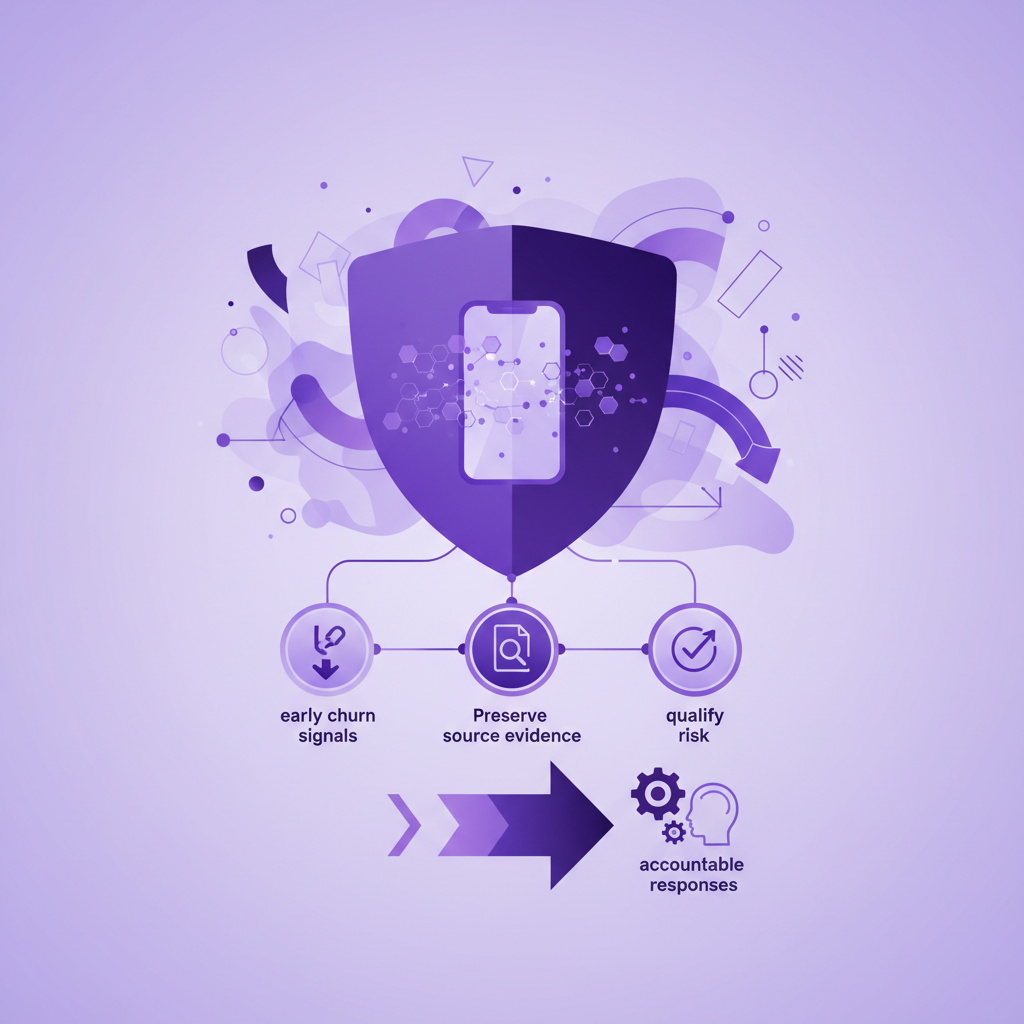
The strongest process keeps source evidence, AI interpretation, human judgement, and action visibly separate.
Step 1: Capture the ordinary mobile call
The workflow starts with the conversation entering Salesforce. If direct mobile calls and customer callbacks are missing, later risk analysis is working from a partial sample.
Step 2: Match the call to the right customer context
Connect the activity to the correct people and business records. Send uncertain matches to review. A confident risk attached to the wrong account is worse than an honest unresolved match.
Step 3: Surface a possible risk signal
AI can help identify language about value, adoption, service, budget, competition, stakeholders, timing, or cancellation. Treat the result as a candidate signal, not a final churn decision.
Step 4: Ask a person to qualify the risk
The account owner or another responsible reviewer should confirm what changed, how credible the concern is, what evidence supports it, and whether the current renewal status needs to change.
Step 5: Create one owned response
Turn the confirmed risk into a specific action with an owner and due date. Avoid vague tasks such as “follow up with customer.” State what the next conversation or action must achieve.
Step 6: Keep the customer response connected
The recovery conversation should join the same account history. If a manager, service leader, or executive calls the customer from a mobile phone, that conversation should not disappear into another private call log.
Step 7: Review whether the risk changed
Record whether the issue was resolved, reduced, unchanged, or confirmed. Keep the reason visible. Closing a task does not prove that the renewal is healthy.
Why sentiment alone is not a renewal forecast
Sentiment can help prioritise review, but it should not become a substitute for commercial context.
A customer can sound positive while explaining that funding has been removed. Another can sound frustrated during a service incident and still have a strong commitment to renew. A procurement contact may use neutral language while introducing a condition that makes the current timeline impossible.
The same caution applies to keywords. A competitor mention might be casual. A request for lower scope might reflect a planned organisational change rather than dissatisfaction. An AI model can surface the moment, but a person should judge its meaning using the account history, stakeholder role, contract position, and exact conversation.
Good automation reduces the time needed to find risk. It does not hide uncertainty behind a score.
What should managers measure?
Managers need measures that test whether the team is finding and resolving risk earlier, not simply creating more alerts.
Useful questions include:
-
What proportion of upcoming renewals have recent customer conversation evidence?
-
How many qualified risks were first heard on an ordinary mobile call?
-
How quickly does a confirmed risk receive an owner and response date?
-
Which risk causes appear most often by segment, product, region, or account stage?
-
How many risk actions are completed with a recorded customer response?
-
How often do people correct or reject an AI suggested risk?
-
Which risks lead to renewal, reduced scope, delay, or churn?
-
Are repeated service, adoption, value, or stakeholder issues reaching the teams that can address their root causes?
The purpose is not to claim that every churn event can be predicted. It is to give the business earlier, better evidence and a clearer response process.
Where does RocketCell fit?
RocketCell is built for Salesforce teams whose important customer conversations happen through ordinary mobile calling.
Using an eSIM or SIM based business mobile service, employees can make and receive native cellular calls through the familiar phone experience. RocketCell can then bring the call activity and conversation context into Salesforce automatically.
Depending on the organisation's configuration and policy, that context can include the recording, transcript, AI summary, record matching, outcome, and suggested next actions. This gives Customer Success, account management, RevOps, and leadership a stronger source record for renewal review.
RocketCell does not predict churn or decide whether a customer will renew. It helps capture the mobile conversations that a responsible renewal process should consider.
Questions to ask before rollout
Before building renewal risk automation around mobile call data, answer these questions:
-
Which account conversations are currently missing from Salesforce?
-
Are direct customer callbacks captured as reliably as planned outbound calls?
-
How will calls be matched to the correct Account and renewal record?
-
Which risk categories are useful enough to support action?
-
What evidence must support a change to renewal status or forecast?
-
Who reviews AI suggested risks and uncertain matches?
-
Who owns each type of customer response?
-
How will recovery calls remain connected to the original risk?
-
Who can access recordings, transcripts, and summaries where they are enabled?
-
How will the business learn from resolved risks as well as churned accounts?
Find renewal risk while there is still time to act
Renewal risk is rarely contained in one field, one score, or one dramatic conversation. It develops through changes in value, adoption, service, stakeholders, budget, and trust.
The account manager's mobile call can be the earliest and clearest evidence of that change. When the conversation is captured, matched, reviewed, and connected to an owned response, Salesforce becomes more than a record of the final renewal outcome. It becomes the place where the business sees risk early enough to do something useful about it.
For mobile teams, that starts with making sure the conversation reaches Salesforce at all.