
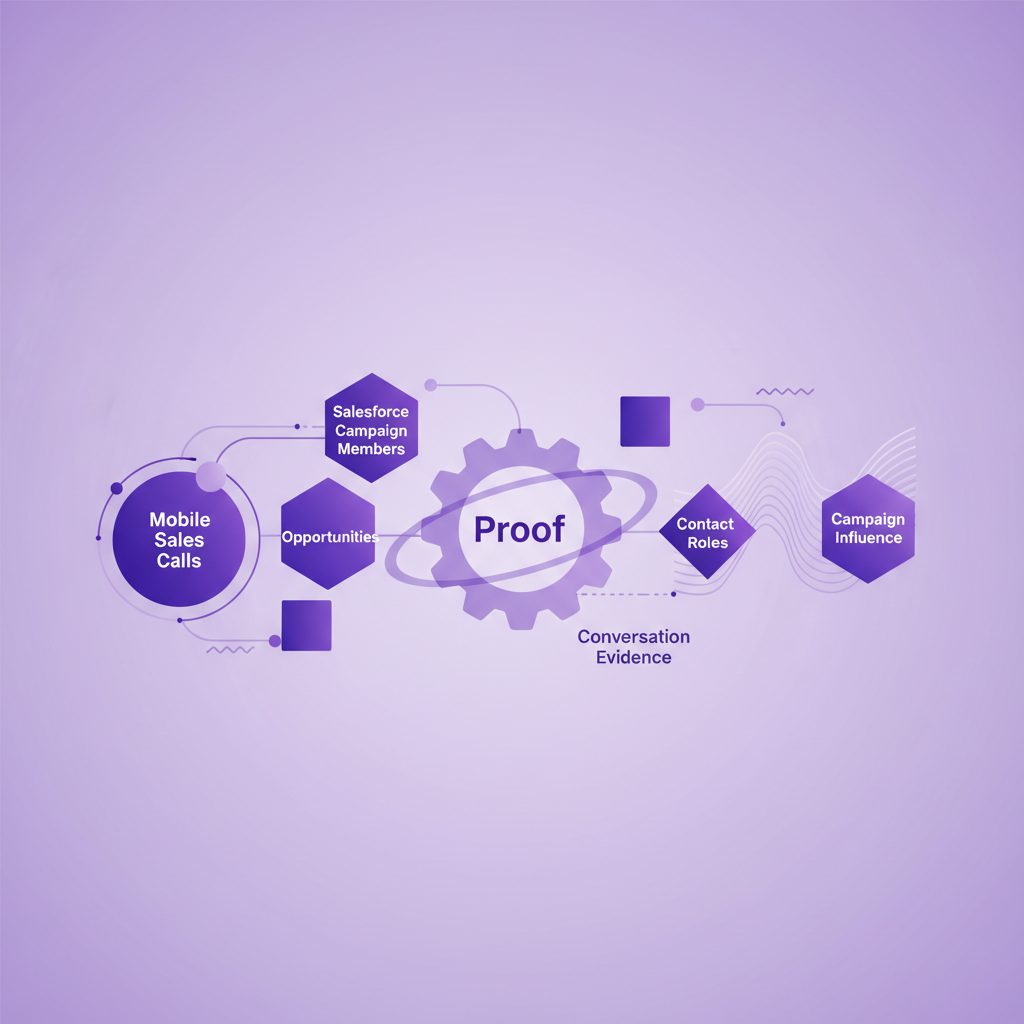
Salesforce Campaign Attribution for Mobile Sales Calls: What Marketing Can Actually Prove
A prospect attends an event, downloads a guide, and later speaks to a sales rep on the phone. The conversation changes the shape of the deal. A new stakeholder appears. A problem becomes urgent. A meeting is booked.
Marketing can see the campaign response. Sales can remember the call. Salesforce may contain the Opportunity. Yet the business still cannot answer a basic question with confidence: what role did the campaign and the mobile conversation play in creating revenue?
This is the mobile call attribution gap.
For field sales teams, recruitment firms, property businesses, financial services organisations, and any company where sellers use normal mobile phones, important conversations often happen outside a controlled dialler. If those calls never reach Salesforce, campaign reporting is forced to work with an incomplete customer journey.
The solution is not to give every call credit for revenue. It is to capture the call, connect it to the right Salesforce records, preserve the evidence, and let a clearly defined attribution model decide what the business can reasonably claim.
What is Salesforce campaign attribution for mobile calls?
Salesforce campaign attribution for mobile calls is the process of connecting a captured phone conversation with the relevant Lead, Contact, Campaign, Account, and Opportunity so marketing and sales can understand how campaign engagement relates to pipeline and revenue.
The mobile call itself is an activity. It proves that a conversation happened, subject to the quality of the capture and record match. It may also preserve the participants, time, duration, transcript, summary, outcome, and next action.
Campaign influence is a separate judgement. It assigns some degree of credit to a Campaign for an Opportunity. In Salesforce, that judgement depends on the campaign model and the relationships between Campaign Members, Contacts, Opportunity Contact Roles, and Opportunities.
That distinction matters. A call can provide evidence that a Campaign Member discussed a relevant need. It does not prove, on its own, that the Campaign created the Opportunity or deserves all the revenue credit.
Why mobile calls disappear from campaign reporting
Digital activity usually arrives with useful source data. A form submission can carry a campaign identifier. An email click can be tied to a recipient. An event registration can create or update a Campaign Member.
A normal mobile call is different. The rep may call a prospect from the native phone dialler after an event. A buyer may return the call directly several days later. An account manager may hear that a webinar influenced a new project during a routine customer conversation.
Without automatic mobile call capture, several things can go wrong:
-
The call never appears in Salesforce.
-
The activity is logged against the wrong Lead or Contact.
-
The Contact is not connected to the relevant Opportunity.
-
The campaign response exists, but the sales conversation that followed it does not.
-
A rep selects a campaign from memory without preserving any supporting context.
-
Marketing receives credit for call volume but cannot see whether the conversations produced qualified outcomes.
Attribution then becomes a contest between incomplete systems and human recollection.
What a captured mobile call can prove
A good Salesforce mobile call record can establish useful facts.
It can show that a known person spoke with a particular rep at a specific time. It can show whether the call was inbound or outbound and how long it lasted. Where recording and transcription are configured appropriately, it can preserve what was discussed and what the parties agreed to do next.
It can also give reviewers evidence about campaign relevance. The prospect might refer to an event, report, advertisement, referral, or product announcement. The rep might follow up with a Campaign Member using an agreed call list. The call outcome might be a booked meeting, a disqualification, a new requirement, or a request to involve another stakeholder.
These are useful facts for sales and marketing. They still need to be interpreted within an agreed attribution model.
What a mobile call cannot prove by itself
A call record should not automatically answer questions it was never designed to answer.
It cannot prove that a campaign caused the buyer to act simply because the call took place after a campaign response. It cannot resolve every case where a person engaged with several campaigns. It cannot decide whether the first touch, last touch, or a custom model best reflects the business. It cannot know whether a campaign mention was decisive, incidental, or prompted by the rep.
AI can help find relevant language in a transcript or suggest a possible campaign relationship. That suggestion should remain visibly different from a confirmed association or an approved influence record.
The safest principle is simple: capture creates evidence, matching creates context, and the attribution model creates credit.
The Salesforce records that need to connect
Reliable call attribution usually depends on several Salesforce records working together.
Campaign
The Campaign represents the marketing initiative. It might be an event, webinar, partner programme, content offer, advertising activity, or another defined marketing effort.
Campaign Member
The Campaign Member connects a Lead or Contact with the Campaign. Member Status can show the response that occurred, provided the organisation has defined its statuses consistently.
Lead or Contact
The person on the phone needs to match the correct Salesforce identity. Duplicate records, old numbers, shared company numbers, and Lead conversion can all weaken attribution if they are not handled carefully.
Opportunity
Revenue attribution ultimately needs a commercial record. The Opportunity supplies the amount, stage, close date, owner, and outcome that campaign reporting uses.
Opportunity Contact Role
The Contact Role connects a person with the Opportunity and describes their involvement in the buying process. Salesforce Campaign Influence commonly depends on the relationship between a Campaign Member and a Contact who has a role on an open Opportunity.
Activity or call record
The captured call supplies the interaction evidence. For mobile teams, it should be matched to the correct person and relevant commercial context. Depending on the Salesforce design, the call may be represented through a Task or another approved call record structure.
No single record tells the whole story. Attribution becomes more credible when the chain is complete and reviewable.
A practical workflow for mobile call attribution
1. Define the question before configuring fields
Decide what the business wants to learn. Call volume by campaign is different from qualified conversations by campaign. Qualified conversations are different from influenced pipeline or won revenue.
Choose a small set of questions that can lead to a decision, such as which events create qualified mobile conversations, which campaigns produce meetings, or which campaign sourced Contacts later become involved in Opportunities.
2. Standardise Campaign Member Status
A registration, attendance, content download, call attempt, live conversation, meeting, and qualified response are not the same event. Define statuses that reflect the customer journey without turning every activity into a new label.
Marketing and sales should agree which statuses represent a meaningful response and who is allowed to change them.
3. Capture business mobile calls automatically
Do not make attribution depend on a rep remembering to create a call note after a busy day. Capture the business call through an approved process and send the activity to Salesforce with consistent metadata.
RocketCell is designed for this part of the workflow. It captures normal cellular business calls through a SIM or eSIM setup and can bring call logs, recordings where configured, transcripts, summaries, and suggested next actions into Salesforce without asking the rep to use a separate dialler.
4. Match the caller to the right person
Phone number matching is useful, but ambiguous matches need a review path. A shared office number, duplicate Contact, converted Lead, or reused mobile number should not silently create confidence where none exists.
Track whether the match was automatic, confirmed, or unresolved. Attribution built on an uncertain identity should remain uncertain.
5. Connect the person to the commercial context
A call linked only to a Contact may still be invisible to the team reviewing an Opportunity. Where the conversation concerns an active deal, connect the activity to the relevant Account or Opportunity according to the organisation's data model.
Check the Opportunity Contact Role as well. The person on the call may be a decision maker, evaluator, blocker, champion, or new stakeholder who is not yet represented on the Opportunity.
6. Preserve the campaign evidence
Record why a campaign association is being considered. Useful evidence can include the Campaign Member relationship, the timing of the response, the call outcome, an explicit campaign mention, and the next action created from the conversation.
Do not bury this reasoning inside a long summary. Use structured fields for reporting and keep the recording or transcript as source evidence where policy and configuration allow.
7. Apply the attribution model deliberately
Salesforce supports different approaches to Campaign Influence, including a primary source model and configurable influence models. Select the approach that matches the way the organisation makes decisions.
The model should define when a Campaign is eligible, which Contacts must be involved, the time window, how credit is allocated, and what happens when several campaigns appear relevant.
Avoid changing the model merely to make a campaign look successful. Stable rules make trend data more trustworthy.
8. Add human review where the decision matters
Automation can associate known Campaign Members, surface campaign language, and flag relevant calls. A person should review ambiguous identity matches, material influence changes, conflicting campaign evidence, and large Opportunities where attribution will affect budget decisions.
Human review is especially important when the transcript contains uncertain language or when an AI suggestion would create or update a revenue bearing record.
9. Report outcomes, not only activity
Call counts are operationally useful, but they do not tell marketing which campaigns created value. Build reporting that separates attempted calls, connected calls, qualified conversations, meetings, created Opportunities, influenced pipeline, and won revenue.
Also show unresolved matches and calls with no campaign context. Missing data is not a footnote. It tells the team where the process still breaks.
Metrics that sales and marketing can trust
A useful dashboard can include:
-
Campaign Members contacted by mobile phone
-
Connected mobile calls by Campaign
-
Qualified call outcomes by Campaign
-
Meetings or follow up Tasks created after calls
-
Opportunities with both a relevant Campaign Member and Contact Role
-
Influenced pipeline and won revenue by model
-
Calls with ambiguous or unresolved record matches
-
Time from campaign response to first live conversation
The dashboard should state which attribution model it uses. Two reports can both be correct while assigning different credit if they use different models.
Common attribution mistakes
Treating every call as campaign influence
A call after a campaign response is evidence of sequence, not automatic evidence of causation.
Giving credit before identity is resolved
An incorrectly matched caller can connect the wrong person, Campaign, and Opportunity. Match confidence belongs in the control design.
Ignoring direct callbacks
The initial outbound call may be easy to associate with a campaign list. The buyer's later direct callback can contain the real qualification moment. Both directions need consistent capture.
Updating Campaign Member Status from vague language
AI may detect interest, but interest is not always a qualified response. Status changes should follow written definitions.
Measuring volume without quality
A campaign that generates many short calls may be weaker than one that creates fewer conversations with clear next steps and relevant stakeholders.
Hiding the attribution model
Reports should name the model, eligibility rules, and time window. Otherwise teams can mistake one method of allocating credit for objective truth.
Questions to ask before rollout
-
Which mobile calls are currently missing from Salesforce?
-
How are Leads and Contacts matched when a number appears on more than one record?
-
What counts as a meaningful Campaign Member response?
-
Which call outcomes should marketing be able to report?
-
When should a Contact be reviewed for an Opportunity Contact Role?
-
Which attribution model is used for budget decisions?
-
How will the team handle direct callbacks and conversations that occur days after the original campaign response?
-
Which AI suggestions require confirmation before Salesforce records change?
-
Can reviewers trace an influence decision back to the original call evidence?
-
How will unresolved matches and missing campaign context appear in reports?
Frequently asked questions
Does logging a mobile call in Salesforce create campaign attribution?
No. Logging the call creates an activity record. Campaign attribution requires the relevant Campaign, person, Opportunity, and influence logic to be connected according to the organisation's Salesforce design.
Should every Campaign Member call update Member Status?
No. A call attempt, a connected conversation, and a qualified response represent different events. Update Member Status only when the agreed definition has been met.
Can AI assign Campaign Influence automatically?
AI can identify possible campaign references and suggest associations. Material influence decisions should follow clear rules, match confidence checks, and human review where ambiguity or financial impact is high.
Do tracking numbers solve mobile call attribution?
Tracking numbers can identify the source of an inbound call. They do not automatically capture later calls between a buyer and an individual field rep, resolve every Salesforce identity, or decide how campaign credit should be allocated.
Where does RocketCell fit?
RocketCell helps close the mobile activity gap by capturing normal cellular business calls and bringing their context into Salesforce. That gives campaign attribution a more complete evidence base while leaving the organisation in control of its Campaign Member rules, Contact Roles, and influence model.
Better attribution starts with a complete conversation record
Campaign attribution will never be perfect, because buyer journeys are not controlled experiments. It can still be useful, consistent, and honest.
Start by capturing the mobile conversations that currently disappear. Match them carefully. Connect the right people to the right Opportunities. Preserve the evidence. Then apply an attribution model that everyone understands.
That approach gives marketing more than another activity count. It gives the business a defensible view of how campaigns, people, conversations, and revenue connect in Salesforce. 2026-09-21T08:09:17Z