
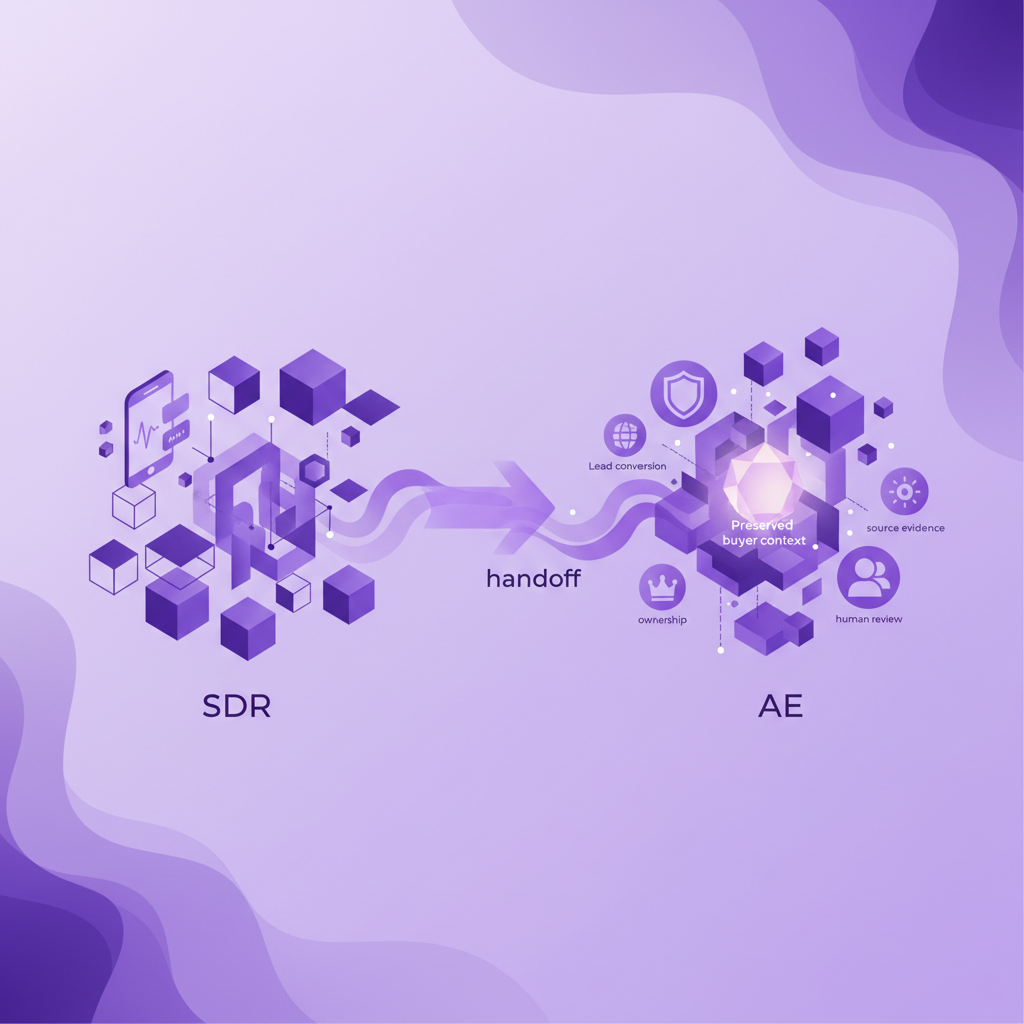
SDR to AE Handoff in Salesforce: What Mobile Call Context Should Transfer?
An SDR books a meeting after a strong qualification call. The Account Executive opens Salesforce before the meeting and finds a name, a company, and a short note that says "interested in a demo."
The buyer then has to explain the problem again.
That is not simply an awkward meeting. It is evidence that the handoff transferred ownership without transferring the conversation.
For mobile sales teams, this happens easily. An SDR calls from the normal phone dialler, reaches a prospect between meetings, and learns why the project matters, who else is involved, what has already been tried, and what must happen next. If that call does not become usable Salesforce context, the AE receives the meeting but not the reason the meeting exists.
This guide explains what an SDR to AE handoff should contain, how mobile call context should move through Salesforce, and where automation can help without turning an AI summary into accepted qualification.
What is an SDR to AE handoff?
An SDR to AE handoff is the transfer of a qualified prospect, the relevant buying context, and responsibility for the next sales action from a Sales Development Representative to an Account Executive.
A calendar invitation is part of the handoff, but it is not the handoff itself. The AE should understand the business problem, the reason for acting now, the people involved, the known constraints, the prospect's expectations, and the agreed next step.
In Salesforce, that context may begin on a Lead and later need to remain visible across the converted Contact, Account, and Opportunity. The exact object model varies by organisation. The principle does not: the buyer's earlier conversation should still make sense after ownership and records change.
Why do mobile qualification calls create a context gap?
Qualification calls rarely happen in one controlled environment.
An SDR may start with a browser dialler but take a direct callback on a business mobile. A prospect may answer only after normal working hours. A field based seller may qualify a referral while travelling. A senior buyer may call the number in an email signature rather than return through the original sales engagement sequence.
These are often the conversations with the best context because they are direct and unscripted. They are also vulnerable to weak capture.
When the call depends on manual logging, the SDR has to remember the detail, find the right record, write a useful note, update qualification fields, and alert the correct AE. Under pressure, a rich conversation becomes a sentence. Sometimes only the call event appears. Sometimes nothing reaches Salesforce.
The meeting can still be booked, so the workflow looks complete. The missing context becomes visible only when the AE prepares for discovery, the buyer repeats earlier answers, or the team later asks why the Opportunity was created.
What context should transfer from the qualification call?
A useful handoff package should be concise enough to scan and detailed enough to trust. It should separate what the prospect said from what the SDR or an AI system inferred.
1. Call identity
Salesforce should show when the call happened, who made or received it, its direction and duration, and the external number involved. This establishes the source event behind the handoff.
2. Correct customer and sales records
The call should connect to the right Lead or Contact and, where appropriate, the correct Account and Opportunity. If several records could match, the workflow should preserve uncertainty for review instead of attaching sensitive context with false confidence.
3. The business problem in the buyer's language
The AE needs more than a category such as "efficiency" or "cost saving." Capture the practical situation the prospect described and why it matters to the business. A direct phrase from the conversation can be useful when access and policy allow it.
4. The reason for acting now
Record the event or pressure behind the timing. It might be a contract renewal, a new target, a system change, a service failure, an executive request, or a deadline. Urgency should be supported by what the prospect actually said, not assumed from an enthusiastic tone.
5. People and roles
Identify the person who joined the call and any other stakeholders mentioned. Distinguish a user, champion, evaluator, approver, budget owner, and signer when the conversation provides that information. Do not convert guesses into confirmed buying roles.
6. Current approach and constraints
The AE should know what the prospect does today, what has already been tried, and which limits are known. These may include budget, security, legal review, integration needs, internal capacity, or a competing priority.
7. Qualification status and uncertainty
Structured qualification fields help teams report consistently, but they should remain traceable to evidence. Record which points are confirmed, which are incomplete, and which need to be tested during discovery.
8. Agreed meeting purpose
The handoff should state what the prospect expects from the next conversation. A product demonstration, technical review, commercial discussion, discovery session, and stakeholder introduction are different meetings.
9. Next action, owner, and date
Every handoff needs one accountable next step. Name the owner, due date, and intended outcome. "AE to follow up" is weaker than "AE to confirm the discovery agenda with the operations lead before Tuesday."
10. Source material where appropriate
Where recording and transcription are configured, permitted, and governed by company policy, the recording and transcript can preserve the source behind the summary. The AE should not need to listen to every call, but an authorised person should be able to review important wording when the decision depends on it.
How should the handoff work in Salesforce?
The best workflow preserves continuity from the first conversation to accepted Opportunity ownership.
Step 1: Capture the mobile call
The conversation must reach Salesforce before any handoff automation can use it. Planned outbound calls and direct callbacks both matter. If only calls started inside a particular app are visible, the qualification history may still be incomplete.
Step 2: Match the conversation carefully
Connect the activity to the most appropriate Lead or Contact. Use supporting context where available, and route ambiguous matches for review. A detailed transcript on the wrong prospect record creates more risk than a clearly unresolved match.
Step 3: Create a structured handoff summary
Summarise the business problem, timing, people, current approach, constraints, meeting purpose, and agreed action. Keep the structure consistent enough for an AE to scan quickly. Preserve links to the source call and related activity.
Step 4: Keep facts and interpretation separate
AI can extract candidate stakeholders, objections, dates, and next actions. The SDR should confirm important fields before the handoff is treated as complete. A detected phrase is evidence for review, not automatic proof that a prospect meets the team's qualification standard.
Step 5: Preserve context through Lead conversion
When a Lead becomes a Contact, Account, and Opportunity, verify where the original call activity, transcript, summary, and qualification fields remain visible. The AE should not have to search an old record to understand the Opportunity.
This is especially important when teams use custom objects or different rules for activity association. Test the real conversion path rather than assuming every artifact will follow automatically.
Step 6: Ask the AE to accept the handoff
Ownership should be explicit. The AE confirms that the context is sufficient, accepts responsibility, or returns the handoff with a clear reason. This creates a useful quality loop between the teams instead of allowing incomplete meetings to drift into the pipeline.
Step 7: Connect the first AE conversation
The handoff is not finished when a record owner changes. The first AE conversation should connect back to the same customer and Opportunity context. New evidence can confirm, correct, or deepen what the SDR learned.
Step 8: Measure the outcome
Track whether accepted handoffs produce attended meetings, qualified Opportunities, clear next actions, and useful feedback. A large handoff volume means little if AEs repeatedly start cold or reject the context as incomplete.
What changes when AI SDRs are involved?
AI SDR workflows can qualify interest, update records, and schedule meetings. That increases the importance of a clear transfer standard.
The human AE needs to know which parts of the record came directly from the prospect, which were generated by the AI workflow, and which remain unverified. The handoff should show the conversation history, the qualification questions asked, the answers received, the meeting promise, and any point where a human took over.
The same rule applies when a human SDR uses AI to summarise a mobile call. Automation can reduce admin and make a consistent handoff easier. It should not hide ambiguity or silently turn an extracted phrase into an accepted budget, authority, need, or timing decision.
Common handoff failures to avoid
The calendar invite handoff
The meeting exists, but the commercial context does not. The AE sees a company name and generic agenda, then repeats the qualification call.
The summary without evidence
The record contains confident statements but no source call, transcript, or indication of what was confirmed. This makes correction difficult when the summary is incomplete.
The Lead graveyard
The original mobile call remains attached to a converted Lead while the AE works from the Opportunity. The information technically exists but is absent from the daily workflow.
The field dump
Every detected phrase is pushed into structured fields without review. Salesforce looks complete, but the distinction between buyer fact, SDR interpretation, and AI suggestion disappears.
The ownership gap
The SDR assumes the meeting means the AE owns the next action. The AE assumes more qualification is required. No one confirms the agenda, and the prospect experiences the delay.
The hidden callback
The prospect calls the SDR directly after the handoff and changes the timing, attendees, or requirement. If that mobile conversation stays on the handset, the AE prepares from stale context.
What should managers measure?
Managers should measure whether handoffs preserve useful buyer context and create accountable progress.
-
What proportion of handoffs include a captured source conversation?
-
How often is the mobile call matched to the correct record before assignment?
-
What proportion of handoffs have a confirmed business problem, reason for acting, meeting purpose, and next action?
-
How often does the AE accept, return, or correct the handoff?
-
How much time passes between qualification and AE acceptance?
-
Do accepted handoffs lead to attended meetings and qualified Opportunities?
-
Which fields are most often missing or corrected?
-
How often does new mobile call context arrive after ownership changes?
-
Can managers trace important qualification claims back to the source conversation?
-
Are buyers being asked to repeat information the business already captured?
The goal is not to score SDRs on how many fields they fill. It is to make the next customer conversation better and the resulting pipeline more trustworthy.
Where does RocketCell fit?
RocketCell is built for Salesforce teams whose qualification and follow up conversations happen through ordinary mobile calling.
Using an eSIM or SIM based business mobile service, employees can make and receive native cellular calls through the familiar phone experience. RocketCell can bring the resulting call activity and conversation context into Salesforce automatically.
Depending on the organisation's configuration and policy, that context can include a recording, transcript, AI summary, record matching, outcome, and suggested next actions. This gives an SDR to AE handoff a stronger source record without asking mobile employees to rebuild the conversation from memory.
RocketCell does not decide whether a Lead is qualified or whether an AE should accept it. It helps ensure the mobile conversation behind that decision is available in Salesforce for responsible review.
Questions to answer before rollout
-
Which qualification calls and direct callbacks are currently missing from Salesforce?
-
Where should the original call activity live before and after Lead conversion?
-
Which handoff fields must be confirmed by the SDR?
-
How will the workflow distinguish prospect statements from AI suggestions?
-
What happens when the phone number matches several Salesforce records?
-
Which source materials can the SDR, AE, manager, and operations team access?
-
What information must the AE receive before accepting ownership?
-
How can the AE return an incomplete handoff without losing momentum?
-
How will later callbacks from the prospect reach the new owner?
-
Which outcome will show that the handoff process is improving?
Transfer the conversation, not only the meeting
An SDR to AE handoff should let the next seller continue the buyer's journey rather than restart it.
That requires more than a calendar invitation and a completed field. It requires the source conversation, the right Salesforce relationships, a concise account of what is known, honest uncertainty, and one accepted next action.
For mobile sales teams, the first step is simple: make sure the qualification call reaches Salesforce. Once the conversation is captured and connected to the records where the AE works, automation can reduce admin and strengthen the handoff without replacing human judgement.